From Boom to Bust (Part 9)

My mom was a powerful woman. She was very intelligent, hardworking, and had a strong will. Her biggest failing, in my opinion, was that she was groomed from an early age to serve the patriarchy. She deeply believed that men should take the lead in things and that her role should be supportive. Yet she held the greater power in her relationship with Walt. It was her house. He needed her to help him write his sermons. She made the important decisions behind the scenes, and he must have resented his dependency. Although I never saw him hit her, she was cowed by his temper. He would call her “woman” in a derisive tone. I one time saw him grip her upper arm, hard enough to leave a bruise. There was a time she brought him toast that wasn’t burnt enough for his taste, and he tossed the whole plate back at her. But in the end she sent him packing. His sudden transformation to meekness and his apology to me, after two years of tyrannical domination, left me shell-shocked and confused. At least he was gone. We all felt a sense of relief and liberation in the aftermath.

Content Warning: discussions of suicide and dark insinuations.

My mom made some big mistakes raising us, but now she did something very right. She hauled the six of us into family counseling. Steve was a PhD psychologist and licensed family therapist, and he was great. I remember all of us sitting in a big circle in his office for several sessions, and as I recall it was a lot of fun. He had a calm and cheerful manner that got us all to loosen up and talk about our feelings. I remember there were these oblong pillow things with handles like swords that we could fence with. It was good times, and it wasn’t long before he said, “I think you all are doing quite well and you don’t need to keep coming back at this point. Except I want to continue to see Kirk.” Wow, I felt so special! I mean that in a positive way — I wanted to keep coming, and never thought about why I might be singled out in a negative sense.

So every week it seemed, for the next three or four years I went to see him. In 1974 most kids didn’t have a therapist, and I thought it made me cool. A year into it I bragged about it to my friends at school and they thought it made me a dark and complicated badass. They already thought I was a musical genius. When they asked me if it meant I was crazy, I said I would ask the therapist. He said, “No, you’re not ‘crazy!’ You’re not a raving basket case. I would would describe you as emotionally disturbed.” That satisfied my friends and me. Steve and I talked about my life history up to that point, trying to identify the turning points. I talked about the pants-down spankings, the way I felt singled-out by my father for extra punishments. I decided I must remind my dad too much of himself and so I got on his nerves. I talked about the Catholic school, the bullying. I talked about how Walt seemed to be a cross between Adolph Hitler and Barney Fife: an insecure loser who overcompensated by being a dictatorial douche. But mostly we talked about the bullying that was ongoing: the jocks at school who were always calling me “faggot,” “queer,” and “fairy,” pushing me in the hallways and punching me in the stomach. “What do they think they know about me?” I asked. “Are you gay?” he replied. And that started a long series of conversations about my sexual orientation. He was a good therapist. I never felt judged or in any way unsafe. I could have told him everything, but I withheld a lot. Maybe it was my age. Maybe it was the desperate need to convince myself that the bullies were wrong about me. I think if I believed that everyone could see who I really was and what had happened to me, if I thought I had failed in my attempts to keep the truth veiled, I would actually have killed myself. So eventually we succeeded in getting me through high school in one piece, but the deepest darkest stuff remained buried.

My sister, Karen, started working as a waitress in a small family-owned Mexican restaurant when she was sixteen. She spent a lot of time at work because she loved it. The other reason was because, due to her good looks and outgoing personality, her two best friends happened to be the richest in town. We were dirt poor, and she needed her own money to fit in, at least in a fashion sense. The owners of the restaurant were wonderful people, very kind, and she was a gifted waitress. One day, a few weeks after Walt left, I came home from school hungry. I looked in the pantry for something to eat and we were out of everything but pancake mix and such. I said, “Mom, there’s nothing to eat!” She was sitting at the kitchen table and, for only the second time in my life, I saw her bury her face in her palms and sob. “I’m so sorry, we don’t have any money. We may have to go on Welfare.” That very moment my sister walked in, home from work, and said, “What’s going on?” My mom seemed so ashamed as she explained the situation. Karen said, “Mom, I’ll loan you $75 so you can get some groceries, and I’ll ask at work to see if we can get you a job.” So for a while my mom bussed tables while my sister waitressed. It must have been a hoot. It wasn’t long before my mom got a part-time job lecturing at the university, and a year later she landed a great position at a community health research clinic as “Director of Intervention” in a multi-year, nationwide study. Like I said, my mom was a powerful woman! Her boss was an internationally-renowned epidemiologist, a Persian MD who got all the credit while she worked herself to the bone cleaning up the messes he created with his imperious arrogance. He was not good with people, but she was. She spent the rest of her career there, working fourteen-hour days to make that place a success. He eventually lost a class action lawsuit for harassment brought by all the other employees. She was probably his chief enabler. But at least we had enough money to get a stereo system, a microwave oven, a new car, and a color TV with cable. We were finally middle class.

Halfway through my ninth-grade year the bullying was getting to be too much. My last period of the day was Physical Education. Whenever PE ended, school was out, and I often found myself face to face with my tormentors. Billy, in particular, was not the scariest, but he was the most persistent. The scion of a very wealthy family, he seemed to take special delight in saying things like, “Kirk, you’re a ‘fairy’ nice guy!” One day he said to me, “You’re such a queer,” and I replied without missing a beat, “You wish!” There did always seem to be a sense of yearning in his pretty blue eyes, so I was calling him out! He responded by physically assaulting me with punches and kicks. I managed to escape and headed toward the band room — a standalone building not far away where my friends and I met up every day after school. That was the very last time I attended PE in junior high! After that I skipped PE and meandered my way over to the band room during seventh period. The band director was a sweet man and never questioned my presence there. I would greet my friends when they arrived after school as if nothing irregular was going on. My sister Karen was off at college now, and I had moved into her old room at the front of the house. My siblings were relieved when I moved the piano into it. They were annoyed at how much I practiced, and this made it less intrusive.

Since my mom was working so much, we younger four were pretty much on our own most of the time. My older brother, Dan, had a motorcycle and a job as a dishwasher at a restaurant on the edge of town. He was gone hanging out with his druggie friends much of the time, and that left me with my sister, Jenifer (two years younger) and my brother, Drew (four years younger). We took turns making dinner, which we would warm up for my mom when she dragged herself in at eight or nine o-clock. She would eat and then promptly fall asleep on the couch while we watched TV. By ten someone would run her bath water, then we would herd her off to the tub. We took turns waking her up, helping her out of the tub, drying her off and getting her moving towards bed. This is how we lived. After a few weeks of skipping PE, I started skipping school entirely. I would get up as normal, make my lunch and load it into my backpack with my books, then head out towards school. I found if I walked halfway to school before turning around to go back home it allowed just the right amount of time for my mom to leave for work. I would sneak back into the house and play the piano all day, talking to the composer Beethoven, whose spirit I imagined sitting at my side, coaching me and discussing his music. He was as weird as me, and we vibed together as I developed a special affinity for his piano sonatas. These were the happiest weeks of my life up to then. It was so nice not to have to deal with school anymore.

One Saturday afternoon my mom was reading the mail and she said, “What is this?” I looked at the letter she handed me. It was from the Department of Juvenile Justice. It said something to the effect of “Your son, Kirk, has been declared a habitual truant and will be made a ward of the court if you don’t respond by” such and such a date. Ooops. She looked at me in pained confusion. “But I see you leave for school every morning before I go to work!” Well, actually. I asked what “ward of the court” meant. She said, “They’ll take you away and put you in foster care, probably a group home somewhere.” What, no more private room with a piano?! This was a crisis indeed. “I’ll call Steve,” she said. I still can’t believe how people rallied on my behalf. I’m so lucky. Steve said he was willing to sign a release to get me out of PE for the rest of the year, and the school counselor told me the principal said they would only accept it because Steve was a doctor of psychology. The only caveat was that I would have to take one more semester of PE before I could graduate from high school in three years. Whew! And the band director said he was perfectly happy to have me as a student aide last period for the rest of the year. I couldn’t believe it, I was getting everything I wanted. But they said I had to sign a written contract, which I was to draft myself. So I wrote up a contract saying I would attend every class until the end of the year on the condition that I didn’t have to set foot in the gym again, and if I had even so much as one unexcused absence I would immediately be made a ward of the court. “Wow, that’s pretty draconian,” Steve commented, “Don’t you want to give yourself three strikes or something?” I straightened my back and said, “I don’t see any reason why I would have any unexcused absences.” So we both signed it. I discovered that merely by showing up to all my classes every day I could easily get straight A’s, and at the end of the year I was even presented the “High Achievement in Music” award in front of the whole school. To this day I still believe that if I had gone into foster care I would have died of a heroin overdose or suicide before the age of twenty. Thank you, Steve, you are still a hero to me!

Radical Acceptance

Tomorrow I will resume work on the thread I have been doing about “From Boom to Bust,” but on this day I feel I should take a moment to offer a few reflections on sobriety. No one asked me to give a speech, but it’s my blog and I have the prerogative to say a few words here if I want to.

Today happens to be Saint Patrick’s Day. It is also the thirty-ninth anniversary of the day I decided to try sobriety one last time. This morning began as all mornings do, fixing a cup of coffee for myself to have during my first chess session of the day. My wife, Sarah, gave me a little squeeze of appreciation as she congratulated me for making it through another year sober. I smiled. A few moments later my phone buzzed with a text message from my ex-wife, Laura, also offering a celebratory sentiment. This year we will have been divorced for thirteen years, having been married for twenty-two years before that. She is the mother of my biological children. I thought to myself that it’s nice that we still wish each other well. My mother sent me a “birthday” card every year for as long as she was able. Reflecting on all this made me think, “Wow, what does it say when there is a general consensus that the world is a better place just because I don’t drink anymore?” I guess my drinking must have been pretty bad.

I came-to that morning of March 17, 1985, which also happened to be a Sunday, after a crazy binge that began Thursday after work. There will be future posts with more details about how I had hardly drawn a sober breath for the previous eight months, but suffice it to say for now that what made this Sunday morning different from the previous ones was not the fact that I was contemplating quitting drinking. What made it different was that for some reason I realized that it was a loop: I had been having these thoughts every Sunday for weeks now. I would resolve to take a break, if only to clear my head and get a little perspective. But by Monday I would forget, and find myself drinking again as if my resolution had never happened. This had been going on for weeks, and only on this occasion did I have the mental clarity to realize I was stuck. Eight months earlier I had come to a point of radical acceptance of my fate. I was moving out of the apartment I shared with my then girlfriend because my new love interest wouldn’t have sex with me as long as I was living with someone else. Why? In her words, “because I’m decent.” That left me no choice but to get my own place. As I was leaving, my girlfriend tearfully asked me why I was being so cruel. I looked at her intensely and said, “I’m doing this to protect you. I’m dying, and there’s not a damn thing you or I can do about it. I’m getting out of your life to spare you.” In that moment I had every intention of dying drunk, and I knew it wouldn’t be more than a year before it happened.

My parents had also reached a point of radical acceptance. They hadn’t heard from me in months, but they had a sense of what was going on. Divorced for years, both of them were attending Al-Anon meetings in their respective towns. My dad had twenty-one years of sobriety at that point, but his biggest challenge had become what to do when your child is dying of the same disease. They prayed for me and had their friends praying for me also. Both braced themselves for the seemingly inevitable bad news that could arrive at any time, probably from a third party, that I had met my end. It was a dark time.

But that morning was different, somehow. The miracle arrived in the form of a question: what if I am wrong? I had acquiesced in the knowledge that it was my fate to die drunk. I had stopped fighting it. I was embracing it. I had burned all my bridges and was just trying to go for all the gusto I could on my way out. People I didn’t even know were stopping me and offering warnings and advice, it was so clear from my behavior that I was going to flame out. It must have been sad to know me then. But that morning, for some reason, it occurred to me that maybe I was wrong. Maybe I wasn’t meant to die drunk. What if I was supposed to recover? That was a terrifying thought, because every aspect of my life was a complete shambles. To try to turn things around now was going to be incredibly difficult. Even just my financial situation was astonishingly hopeless. I had just lost my latest girlfriend, I was about to lose my job, and it seemed like no one at all was buying my horseshit anymore. I had run out of cash and had only enough in my pocket to buy a pack of cigarettes or a six-pack, but not both. When I realized that I had been vainly trying to stop for several weeks and forgetting each time, I realized that this might be my very last chance.

As I sat there contemplating the question of which fate I might be destined for, another question hit me. What if it’s a lie? What if the one thing that has been making my life a little bit bearable, the one thing that gave me a moment or two of relief from the hatred I felt for life and for myself was actually causing all the problems? What if instead of being my one true friend, alcohol was actually what was killing me? If that were true, I owed it to myself to at least try to get sober one last time. Ugh. But if it were true, and I were to pick up that next drink and begin the slippery slide to oblivion knowing what I knew, it would be very embarrassing, to say the least. What a fool I would have been! So, that’s how it started. All these years later, I have still not picked up that next drink. It turns out that it was not my destiny to die drunk after all.

I brought my phone to my wife to show her the text from my ex-wife, and made a wry comment about how bad my drinking must have been for everyone to celebrate the fact of my sobriety. But neither my current wife nor my ex-wife has ever seen me drink! Sarah said, “Well, it’s always been clear that your sobriety is very important to you, so I’m happy for you.” I didn’t know whether to laugh or to cry. Of course it’s very important to me. It is the foundation of every good thing in my life, everything valuable thing about me as a person. Yes, it’s very important to me. Sometimes I mention to someone that I have been sober for a long time and they respond with, “You must be very proud of yourself!” No. I went back to college in my fifties, thirty years after I dropped out, and busted my butt over the next three years to graduate with a double major, summa cum laude. I am very proud of myself for that! But sobriety? I only feel gratitude for it. Grateful that I escaped the whirlpool and I don’t have to do that shit anymore. And I am grateful every single day that none of my kids has ever seen me drink. Very grateful, indeed.

I wrote a post a few years back called The Wisdom Prayer in which I talk about how pointless it is to accept anything that is not an actual fact. For example, for thirty years I accepted the “fact” that I had missed my chance, that it was too late to go back to college! People in recovery sometimes seem to elevate the idea of Acceptance into some kind of general principle, as if it is the key to everything. But like trying to use a screwdriver when what you need is a wrench, practicing “acceptance” in the wrong situation can keep you stuck in a victim mentality. In such situations what is needed is Courage, and to know that, you need Wisdom. But I want to share something, a fact which I have accepted as such all the way to the core of my being. When I think about all the things that could possibly happen to me — illness, bankruptcy, tragedy, horror — I am unable to imagine a situation that I couldn’t make worse by taking a drink. Honestly. That particular form of radical acceptance keeps me sober.

This is the first year I can remember where I haven’t had a single drinking dream. You know, the nightmare in which I am at some sort of social gathering walking around talking to people with a half-finished drink in my hand. I suddenly realize that I am drinking and wonder, how long have I been doing this? And in the dream I think back and realize that it has been happening for a while now, and that somehow I have lost my sobriety without even noticing. I take these dreams as a warning. In my youth (I was twenty-three when I took my last drink), whenever I would resume drinking after a few weeks or months it would happen without fanfare. No drama. I would just “forget” somehow that I wasn’t drinking. I have no doubt that if I were ever to start drinking again it would happen like that. Terrifying! But I haven’t had any of those dreams this year, thankfully, not even during the Annual Dreary Rehash. The past year has had it’s share of challenges — a couple of colonoscopies, people around me having mental and physical health challenges, financial stress, a sense of impending doom for Western Civilization — but I have a good life. I believe that as long as I am grateful every day for the gift of release from the horrors of alcoholic drinking, I will be fine.

From Boom to Bust (Part 8)

The last installment ended with a teaser about the next two years, and there will be a lot more detail and analysis in future posts. For the purposes of this thread, going from barely being a baby-boomer to fully joining Generation-X, I will start with a snapshot of how the two years ended. One August day I was sitting at the playroom table playing with the chess set. I think I had just finished a game with one of my brothers (“almost fifty-years-ago” is a long time to remember tiny details). I heard some commotion as people moved through the house from room to room. This big old Victorian house had a lot of rooms and most of them (all but two) had doors connecting them to multiple other rooms. For example, the “girls bedroom” had four doors, one leading to the middle living room, another to the dining room, another to the adjacent bedroom, and the fourth leading to the master bathroom. The playroom opened to two different bedrooms, the dining room, the laundry room, and the back bathroom. There were any number of potential paths through the house! I heard voices and footsteps making their way on one such path, people talking, more footsteps. Something was off, but I was locked into the fascination of what I was doing and was suppressing my growing sense of unease. Walt emerged from the boys bedroom and stood over me, my mom, sister and brother trailing behind. I looked up, flinching a little in preparation for whatever might be coming, but was shocked to see tears staining his face. I had never seen him like this — he had become a completely different person yet again. He seemed smaller, cowed like a contrite child. And then he did the weirdest thing: he stuck out his hand for me to shake, which I did, and through his tears he said, “I’m sorry.” As he walked away, someone whispered to me, “He’s leaving.” Mom had finally stood up and told him it was over.

Content Warning: This post contains a graphic depiction of domestic violence.

Victor Frankl in his book, “Man’s Search for Meaning,” describes the reaction of the prisoners when the Allies unlocked the gates of the concentration camp in which he was interred. They wandered out the gate into the forest, looked around a bit, then went back to their barracks. They couldn’t yet process the reality of the liberation they thought would never come. I was similarly in shock. In fact, all of us kids were showing clear signs of trauma, which had led my dad to ask his lawyer about beginning a custody challenge. But my mom had already begun to take control of the situation. To give Walt time to leave and to allow us to decompress, we were sent to spend a week at my dad’s. My eldest sister, who had previously gone to live with him, was now eighteen and a militant lesbian. She came at my mom’s request to stay with her in the interim, lest Walt return to cause trouble. It was decades later when I learned from her that she had borrowed a gun from a friend, just in case. So the consensus seems to be that the situation had become pretty scary.

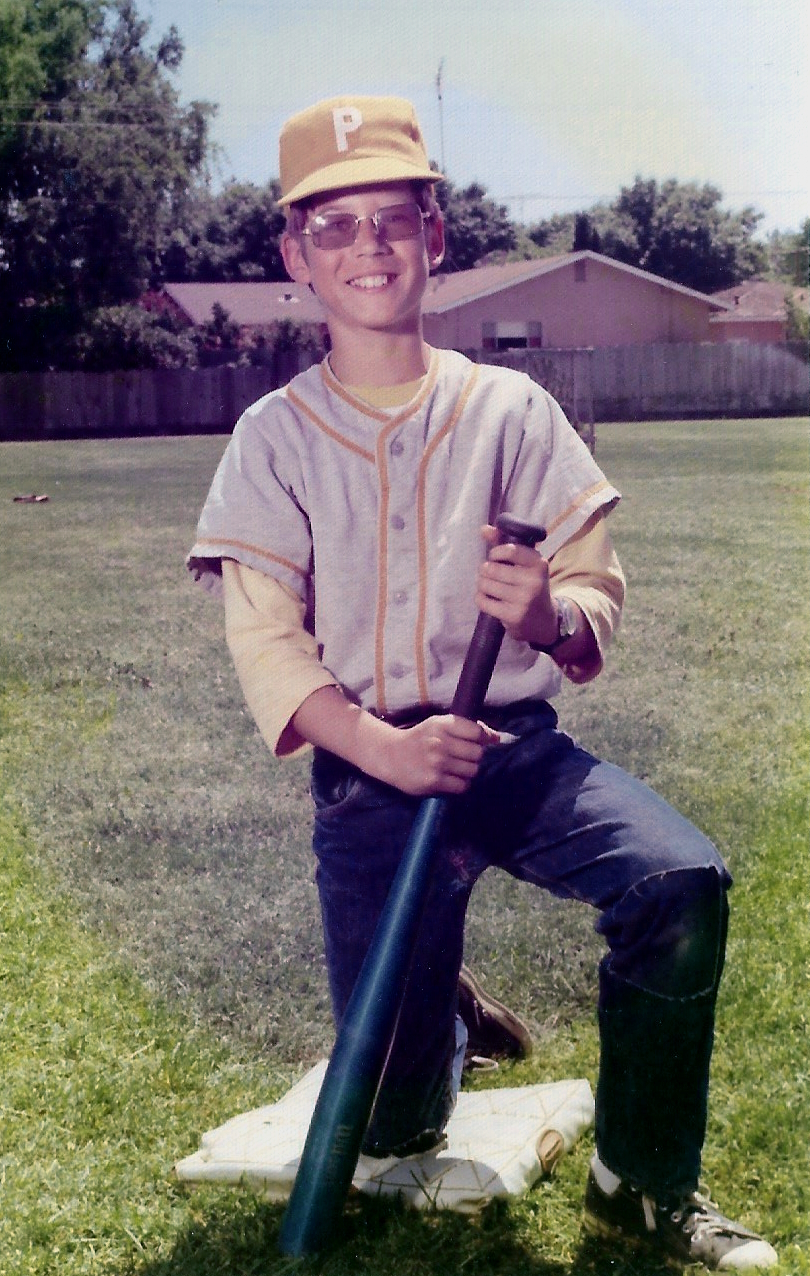
On a lighter note, I want to tell you how my infatuation for baseball ended the previous year. There were three levels of little league: majors, minors, and California league, in order of skill level. My first year I was in California league (my team’s name was “Bakersfield”), but in my second year I was good enough to be on a minor league team, the Padres. So I guess we can say I was an intermediate player. I usually played right field or second base, although I do remember subbing at third base on occasion. I was once shocked by the speed of a line drive that came right up the third-base line. I caught it, but boy did my palm burn from the impact! I decided I preferred second base. Anyway, we were a pretty good team that year. Our hitting and fielding were strong, but our pitcher…he was the head coach’s grandson and had a love for baseball that exceeded his talent. He was a real pitcher: he could throw fastballs, change-ups, curves, and sliders. The one thing he couldn’t do was throw the ball over the plate. Every single inning it seemed the bases were loaded with runners who had been “walked.” If only we could find a way to get our other players into the game! So one day at practice, in despair, the coach let each player on the team take a turn at pitching. I had no idea about fancy aerodynamic techniques that required putting spin on the ball, but I could throw hard, fast, and straight. All those hours throwing balls against the back steps finally paid off, I guess. So I became the new pitcher! I met someone later who remembered playing against me, and he said, “Oh, I remember you! I loved coming up to bat against you, because you would throw it straight over the plate. I could always hit it!” At least I wasn’t walking people. And when they did hit my pitches, which was often, it created a chance for the rest of the team to deploy their skills, which were very good — so good that we found ourselves in the championship game at the end of the season! Sadly, it all ended in a Charlie Brown moment when I had to be pulled out during the game because for some mysterious reason I just couldn’t throw straight and we ended up losing the game. It was weird. Only later did it occur to me that playing for hours the previous day in a neighbor’s swimming pool was the cause. It was something we all knew not to do the day before a game, but I had forgotten all about it! It’s so sad to think that I was on the verge of being a hero, and wound up being the goat. After that I aged out of little league and was not good enough to continue to the next level. But by that time I was discovering my musical talent, which changed everything.

During the two years of my mom’s marriage to Walt our world was sharply bifurcated into two irreconcilable realms. My dad had become a laid-back, west coast, “enlightened” male. (The pants-down spankings had ended when he moved up to Washington for grad school.) He and his wife didn’t have a television, but did have a nice stereo and a collection of classical, folk, and jazz albums that we could listen to around the fire. I remember him smiling through his beard as he put on his apron to cook his classic eggplant stew, a recipe he found in Sunset Magazine. During the summer we would walk through a redwood grove to get to the edge of the Russian River a quarter mile away from their house, hanging out on a patch of sand where the little creek fed into the river. Directly across from us was a famous nude beach where dozens of naked hipsters would peacefully relax to the sound of bongos or guitars, the smell of weed often wafting in the air. My dad, stepmom, and sister would routinely skinny dip too, and we younger kids who didn’t live there all the time were free to join in if we wished. Family nudity in that setting never seemed awkward or uncomfortable to me, but it would have been unthinkable in the context of the rest of the extended family. The tone at my mom’s house was utterly different. Walt was a bit of a country bumpkin. He had no taste or sophistication of any kind. Whereas my dad would play the ukulele and sing Woody Guthrie songs, Walt could perform only one song: “How Great Thou Art,” a plodding, cringey, hymn. Whereas my dad could entertain a large audience to thunderous applause, whenever Walt performed his song people winced, either from the forced baritone of his untrained voice, or from the forced emotional display of his performative Christian faith. Because let me tell you: in spite of being a minister, that man was a spiritual pygmy. (Oops, no offense to actual pygmies, who no doubt possess authentic indigenous spirituality.)

One of the many things I used to love about professional baseball was the singing of the National Anthem before the game, with all the pomp and ceremony. Back in those days the solo was not a performance, per se, but was for the purpose of leading the crowd in singing. That seems to have been long forgotten, as now-a-days pop stars often butcher it in a way that leaves the audience out. I loved singing along. The cultural divide between the two households can be seen in how my two father figures differed on their assessment of the suitability of The Star Spangled Banner as a national anthem. For Walt it was a sacred hymn, and to besmirch it would be equivalent to flag-burning or blasphemy. But my dad had a more nuanced view. He pointed out that the verses of the poem were damn-near unintelligible, and if one did do the work to parse them out, the meaning was mostly militaristic. Plus, it was set to the tune of an old drinking song that required a range of a full octave and a half, something only trained singers can handle well, and then only when it’s “in their key.” America the Beautiful, on the other hand, is a lovely yet sing-able melody with words that warm the heart with vivid images of the natural assets of our land. There was no comparison: the latter should really be the national anthem.

One day, when I was twelve, Walt was watching the beginning of a baseball game on TV and I stupidly decided to articulate my dad’s position on the question of the two songs right in the middle of the singing of the anthem. Bad timing, I guess, but it also poked at the heart of a war that had been quietly raging between them for influence over my soul. It seemed I might be choosing sides. Walt became very angry that I would have the audacity to question the unquestionable nobility of our sacred national song, and voices were raised as we argued back and forth. I finally blew up and shouted at the top of my lungs, “I HATE the national anthem!!!!” and ran from the front living room all the way through the middle living room, dining room, and girls bedroom to finally arrive at the boys room. I slammed the door behind me and threw myself on the bed, sobbing.

In fact I did not hate the National Anthem. I loved it dearly and I dreamed of being able to lead the crowd at a baseball game in the singing of it myself one day. (It so happens that I have, many times, as lead in a barbershop quartet, but I digress.) But that’s not really what any of this is about. This is about the war between “The United States” and “America,” between Pepsi and Coke, between Jazz and “Country” music, Blue and Red, my safe cool dad versus this toxic troglodyte in a tractor hat. Boom, boom, boom, boom, I heard heavy footsteps on the wood floors coming towards my room. The door burst open and he pounced, slapping and punching me about the head and shoulders. I tried to shield my head with my arms, so he pulled them down to my sides and straddled me to keep them pinned as he continued his assault. This was the most uncontrolled rage I had ever witnessed from him, and that is saying something. Of course, the whole family arrived right behind him. I remember my older sister, Karen, shouting, “get the hell off him, you asshole!” and my two brothers actually trying to pull him off. As usual, my mom stood there, helpless in the moment. But as I described at the beginning, she was ultimately able to get him out, and thus began our next chapter.

Me at eleven.

From Boom to Bust (Part 6)

Before I continue my story I want to pause and check in. I thought it would only take about a half dozen posts but we are barely halfway there, so I apologize. It’s also taking more time for me to draft each post as we go, as my memories get very muddled in these middle years, and the topics are increasingly complex and painful. But if you are reading this I take it to mean that something here has grabbed your attention enough to get you this far, and I think if you stick with me you will be rewarded. I also want to say that, as dark and hideous as things are about to become, everything I write is from love, compassion, and gratitude. I have reached a place of healing and equanimity, and it is the hope that something I say will help someone somewhere that impels me to write. So, thank you.

My dad and his new bride relocated to the wine country along the Russian River, a couple hours away by car. We visited one weekend a month. He was a reliable ex-husband, always picked us up when scheduled and never missed a support payment. Unfortunately, it was not enough to survive on without my mom getting a job. She was a registered dietician and found work in institutional settings such as retirement homes and Meals-on-Wheels. We got by. She found friends in the Al-Anon groups she had been attending for years and spent many hours on the telephone “talking program.” She eventually started dating one of the men she met at a group.

Not long after my dad and step-mom established their cool hippie lifestyle in a rented cabin across from a Russian River resort, an incident occurred that shifted the configuration of our family significantly. My eldest sister, Stephanie (I have decided to start using first names), was a classic “problem child.” Famous for her outbursts of temper, anti-social antics, and frankly bizarre manners and beliefs, she could be forgiven for two reasons right off the bat. She was a genius, frankly. She told me once that beginning at the age of fourteen she read between one and four books a day. A. Day. And she remembered everything: author, publisher, year, table of contents. She could not only quote what they said, she could explain what was good and bad about it, and what others thought. Amazing. I remember one time not too many years ago discussing a rather thorny topic with her, one that not everyone even knows exists. She popped out with, “Well, have you read [such and such a book] by [three authors]? It’s from the early 1980s, so it’s a bit dated, but in the third chapter they talk about [such and so] and they say [this].” She was not showing off: it was truly helpful to my understanding of the subject. (She passed away in 2016 and I am tearing up writing this: I miss her so.) The other reason was that she was born with a congenital syndrome that required her to have dozens of surgeries over her lifetime. Developing cancer was a side-effect of the syndrome. She lived with post-metastatic cancer for twenty-five years before succumbing. So the second reason was that she had suffered a lot from this malady, and frankly just never really felt well.

In her early teens, Stephanie and my mother would get into arguments on a regular basis. It was like two cats fighting, because my mom was gifted as well. The volume would increase and the pitch would rise as their verbal kung-fu fights soared. On this particular occasion the crescendo was suddenly punctuated by a loud pop, a horrid gasp from my mom followed by a quiet “oh,” and then silence. We all gathered around to find my mom looking down at the floor, a hand held to her reddening cheek while Steph stood there panting, arms at her sides, staring as if she had just come out of a trance. Everyone was in disbelief. Had she slapped Mom across the face?!?! Inconceivable. Silently my mom made her way to the telephone a few steps away, sat down and dialed. “Ed?” she said. “You’re going to have to come pick up Stephanie. She’s going to have to live with you. I just can’t handle her anymore.” Stephanie never lived in our house again. My dad was good with her. It turns out his master’s degree was in working with at-risk youth, drop-outs who were working to finish their high school education. His libertine lifestyle and laid-back vibe turned out to be a good fit for her, since she was already hanging out with bikers and using drugs. He had only a few simple rules for her and she followed them.

So my middle sister, Karen, one year Stephanie’s junior, took on a lead role as Mom’s assistant as we continued muddling through as a single-parent household. In another year, my Mom would remarry, but that is for the next post.

My Dad and I Wrote to Each Other

I don’t even know if Grandpa Norris was literate, growing up in an orphanage and all. I do know that my grandma and her second husband were only educated through the sixth and eighth grades. They could definitely read and write: my grandma wrote folksy poetry and songs, and my grandpa taught himself calculus and got his ham radio operators license. It’s just that public schooling in the United States was still pretty sketchy in a lot of places a hundred years ago. So my dad’s parents were marginally educated, working class people. But my dad and his half brother were artistically inclined. My uncle made his living as an artist/painter, and my dad went to college and became a high school teacher. My dad had many talents, actually. He had a lovely singing voice, entertaining audiences with Woody Guthrie tunes, strumming away on his guitar or ukulele. He and a buddy had a nightclub act full of songs and jokes. And he was a radio DJ on weekends, had a column in the local newspaper, and started the theater program at our high school. He was always in demand as a public speaker, sweetening his insightful remarks with hilarious one-liners. But mostly, he wanted to write “The Great American Novel.” Never did, though. He planned to in retirement, but unfortunately he already had stage four lung cancer when he retired. He died at sixty-six. I am sixty-one now, so I think about that a lot. Maybe that’s why I retired early, to try to beat the clock.

My English teachers heaped praise upon my writing, beginning in seventh grade, when my teacher exclaimed I was a budding Will Rogers. I had no idea who that was, but she thought an essay I wrote was particularly funny. In high school my creative writing teacher tried to get me to submit a story to a national competition, saying I was one of the few students he’d had who might have a chance to make it as a writer. And so forth. I always figured I would spend my twilight years punching out some stories. And here we are.

All this to say that my dad and I didn’t fight with light sabers. We penned missives. We saw politics and economics through the same lens, so we didn’t fight about such things. But over the course of our lives I think we both cared a lot about what the other one thought of us. So when we wrote to each other there was an undercurrent of urgency, maybe even desperate hope. Because we both felt we were poorly understood by other people, we found in each other a certain fraternal affinity. Nevertheless, we often disagreed about each other’s priorities in life. Most notably, when I was on the verge of entering into a hasty marriage with my high school sweetheart just shy of my twentieth birthday, he wrote me a twelve-page handwritten letter begging me to reconsider. I thought he didn’t know what he was talking about. Yes, he made excellent points, and the similarities with his ill-advised marriage to my mother were numerous, but I was offended that he thought I was as stupid as he was. I knew what I was doing! Three years later I stumbled upon that letter. The marriage had only lasted a year and was a total disaster, as he predicted. As I reread his words, only for the second time, I realized he knew of which he spoke. So, another eight months down the line, when I hit alcoholic bottom, perhaps I was more open to reaching out to him than I would have been. It saved my life.

The roles reversed a little towards the end of his life. He was going through some deep therapy and seemed to be flailing about, while my life had really come together after a decade of sobriety. So we wrote to each other frequently. He was grateful for my helpful insights. My next post will touch on some of what was going on, and what I think about it all now.