From Boom to Bust (Part 5)

Now that I was back in my old public school things were better. It was a relief to be surrounded again by friends, and the teacher — who did run a tight ship — was nice and supportive. Yet I continued to have problems with school work. Over the next few years I found it difficult to complete assignments. Reading and writing were painful and slow. Math got progressively more confusing. By the time we got to estimating square roots in the sixth grade I gave up. It was becoming too vague and frustrating. Through the rest of elementary school my mom would return from every parent/teacher conference with the same refrain, “They said you could be getting the highest grades in the class if only you would apply yourself.” And yet, somehow, I did well on every test. What they didn’t know was that while I was often disrupting the class, talking to peers, and only rarely doing homework I was hearing and retaining everything that was said. I understood things well enough that when a test came, I would focus really hard on it and somehow came up with the right answers. My spelling was exceptional, even if my reading was slow.

Towards the end of third grade my mom signed me up for tee-ball. For my readers outside the USA, let’s say that tee-ball is just baseball, but instead of having a pitcher the kids hit the ball off a rubber tee. I had always been coordinated and athletic. I could throw, catch and hit a baseball. I was a fast runner and had quick reflexes. I should have been good. But I found myself stuck out in right field where they put the weaker players, and since there were no lights on the field where we played at sunset, I found it more and more difficult to follow what was happening in the fading light. One evening I was standing out in right field waiting for the kid to hit the ball. I saw him swing and — crack! — I saw the ball flying straight toward me. I began to run back to catch it, but suddenly it changed direction and flew off. It was a bird. The ball had actually gone to left field. My mom was watching me and realized she needed to get my eyes checked. Once I got glasses it hit me how nearsighted I had been for a while already. I was so excited to see that stars are actually pinpoints of light, not fluff balls! Perhaps this explains a little of my trouble in school: I couldn’t read the blackboard without glasses. No wonder I developed an auditory learning style. Even with glasses reading strained my eyes, and I had to get higher and higher prescriptions every year. I remember doing timed reading in sixth and seventh grades and my reading speed was half the class average. But my comprehension was near 100% and my vocabulary was at the college level. No one said it was dyslexia but…it was dyslexia.

My dad came home to visit over Easter break my fourth grade year and we had a big family meeting. Our parents explained to us that they weren’t going to be living together anymore, that when my dad finished school in a few months he would be getting an apartment in town and there would be two households. It actually sounded kind of fun, the way they told it, but my siblings were all crying. I didn’t understand why, so I said, “It sounds like it will be good to have two households, why are you all crying?” My middle sister, who always seemed to be plugged-in to whatever was going on (she is four years older than me) turned to me angrily and scolded, “Mom and Dad are getting a divorce!” Now I cried. I felt like a complete idiot. Of course that’s what it meant, why didn’t they just come out and say it? They were like that. They never fought in front of us. They thought it was “important to present a united front.” That left us all wondering though, why were they getting a divorce? It was decades before I received a clear answer from my dad, less than a year before his death.

That summer my dad got his own place, a small apartment on the north side of town. And there was someone living there with him: a lovely young woman some fifteen years his junior whom he had met in school up in Washington. She was starting a career teaching third through fifth graders, and she became my stepmother. Their wedding took place when I was eleven, at a small church in the countryside. Her parents shocked everyone by showing up to it. They were upper class folks and she was their only daughter. They had been appalled to find out that she was in a relationship with a married man who had six kids and was a recovering alcoholic no less. Scandalous! They had expected so much more from their daughter. But I am told that upon meeting us kids the first time they instantly fell in love, welcomed us into their lives and always treated us like princes and princesses. On our part, my dad and step mom gave us intensive training in etiquette and table manners so that when we went to visit them in Portland, Oregon we wouldn’t disappoint them. Today I am happy to have my stepmother as my last surviving parent and, as my mother assured me before her own passing, she is fulfilling the role of benign matriarch quite admirably.
From Boom to Bust (Part 2)

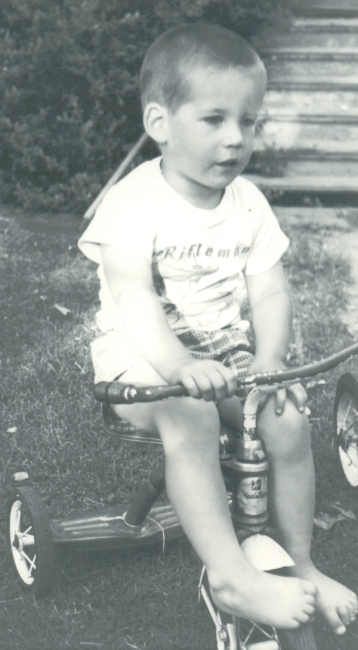
My mother told me that when I was a preschooler I would hop out of bed as soon as it was light, throw on a pair of shorts and a shirt and head out into the back yard by myself to play. I could play for hours in the dirt. I loved my Tonka trucks. I loved the grass, the bugs, the leaves, the garden snails. I remember enjoying the taste and texture of dry mud chips dissolving in my mouth. I knew what everything tasted like: the metal railing on the steps, red bricks, sticks, dried snail trails. I played with the garden hose, being fascinated with water and its effects. I threw rocks, climbed trees, built roads with my Tonka bulldozer for my Matchbox cars. I remember stuffing dried weeds down the front of my shorts to see what that felt like. We had fruit trees: plum, orange, olive, pecan, walnut. If it had rained, there were earthworms and snails to play with. Reading over this I see that I have mentioned snails three times. Seems about right: they were fascinating friends. I just could never seem to get enough sensory input. It fed my mind.

My mind was the other source of fascination. What went on in my head was every bit as rich and colorful as what came in from the outside. In fact, everything had two forms. The physical form and qualities, associated processes and phases, the functional context of the thing: we’ll call that its physical reality. And within me, whether as a pattern of understanding in my mind, or in a spatial sense felt throughout my whole body, the multidimensional representation of the thing was every bit as real to me. And my imagination was so vivid I was prone to nightmares. The earliest memory I have of waking up screaming from a nightmare left a permanent imprint. I can still picture it perfectly. It was a still image, as if in a book. Imagine one of those pictures of a fetus, clearly viewed within its amniotic sack. Also, imagine a picture of the Virgin Mary, where she is framed in curved layers of color that bend around her shape. OK, but the fetus being viewed from the side has its head turned toward the viewer, staring at you with piercing eyes and a large-toothed sinister grin, as if to say, “I’ve got you now, haven’t I?” I am still horrified picturing it. But I also remember my mother coming into the room, holding me, saying, “It was only a nightmare.” In a future post I will tell the story of the Mummy Box, but it will have to wait.

When weather made the outdoors less hospitable, I would play with blocks, Legos, Barbie dolls, crayons, etc. I also spent hours browsing the encyclopedia volumes. I would get so absorbed in whatever I was doing I wouldn’t hear my name being called. I would be forcibly yanked out of my trance and hauled off to the back porch for a “pants-down spanking.” I’m sure all of my siblings experienced the ritual, but I couldn’t make it a week without getting one. My mom said that afterwards I would behave better for a while, but with each passing day I would drift more and more into my private world until they felt no choice but to give me another one. Of course sometimes it was for outright misbehavior. I remember being four years old sitting out on the front steps eating an orange. Suddenly the need to pee became urgent, and rather than going all the way into the house to the bathroom, I decided to drop my pants to my knees (there was no button or zipper) and relieve myself in the front hedge. Midway through I heard my dad’s car drive up. He must have been surprised to see my bare butt facing straight out at the street. I was just finishing as he walked up behind me. I turned to look at him as I reached for my pants but he said, “Leave ’em down.” I waddled like a penguin all the way around the side of the house to the back porch to get my spanking.

I am some kind of neuro-divergent. I found the spankings traumatic, especially for the way I never seemed to see them coming. I truly was absorbed in a private world that others couldn’t understand. For my part, I could never seem to grasp the social world that everyone else lived in, where they just seemed to know automatically what was going on, when dinner time was or what they were supposed to be doing. I was confused much of the time by all the goings on. I think I must have retreated to my own spaces as a way of coping. As I said in the previous post, it was a large and noisy family. I cherished my private time. I didn’t know until much later in life that my dad’s upbringing included regular beatings from his adoptive father. You know: slapping, punching, kicking, all that. In administering corporal punishments to me he was very methodical and self-controlled. Once my pants were down around my knees and the green switch was in his hand he would always say with sadness, “Now son, this is going to hurt me a lot more than it’s going to hurt you.” That never made any sense to me, given that I was the one screaming and crying, but I now understand it to mean that he was trying to do better than his own father, who simply lashed out in uncontrolled rage.

We lived a mere half a block from the elementary school, which had once been the high school before the town grew. It had an old wing, which was a classic multi-story brick building with white-framed windows like you see in all the movies. There was also a newer wing where all the classes were held, as the old wing was condemned and was eventually torn down after I had moved on to junior high school. But I do remember the summer I turned five my mother took me to the old wing for some kind of testing. My memory is not super-detailed, but I remember it was fun. They showed me shapes and had me solve some puzzles. Many years later my mom told me that some time after the tests she got a call from the school district office. They said something like, “We’re sorry, but we are a small town school system and therefore we don’t have any special programs to offer your son, but his IQ is unusually high, and you’re going to have to do the best you can to provide for his needs yourselves.” So my parents began buying educational games and resources. I remember going to hear the orchestra and watch ballet. There were lots of museums, day trips to San Francisco, art galleries. I think all of us kids really enjoyed it, but I was surprised to learn that it was a concerted effort on my behalf. It didn’t work. I struggled in school anyway. It turns out I was dyslexic, but I didn’t figure it out until I was nearly fifty.

I remember loving school from kindergarten through second grade. I was definitely the smartest kid in the class. I could be disruptive, because I had trouble staying with the program. My mind would be racing because, of course, my rich and colorful inner world went with me to class. Sometimes I would just keep talking when I was supposed to be reading or doing class work. I would disrupt the class by interrupting the teacher with a comment that would have the whole class bursting with laughter, including the teacher. My teachers loved me but I was also very frustrating to work with. Everything changed in third grade, but that story will have to wait until the next post.