
The last installment ended with a teaser about the next two years, and there will be a lot more detail and analysis in future posts. For the purposes of this thread, going from barely being a baby-boomer to fully joining Generation-X, I will start with a snapshot of how the two years ended. One August day I was sitting at the playroom table playing with the chess set. I think I had just finished a game with one of my brothers (“almost fifty-years-ago” is a long time to remember tiny details). I heard some commotion as people moved through the house from room to room. This big old Victorian house had a lot of rooms and most of them (all but two) had doors connecting them to multiple other rooms. For example, the “girls bedroom” had four doors, one leading to the middle living room, another to the dining room, another to the adjacent bedroom, and the fourth leading to the master bathroom. The playroom opened to two different bedrooms, the dining room, the laundry room, and the back bathroom. There were any number of potential paths through the house! I heard voices and footsteps making their way on one such path, people talking, more footsteps. Something was off, but I was locked into the fascination of what I was doing and was suppressing my growing sense of unease. Walt emerged from the boys bedroom and stood over me, my mom, sister and brother trailing behind. I looked up, flinching a little in preparation for whatever might be coming, but was shocked to see tears staining his face. I had never seen him like this — he had become a completely different person yet again. He seemed smaller, cowed like a contrite child. And then he did the weirdest thing: he stuck out his hand for me to shake, which I did, and through his tears he said, “I’m sorry.” As he walked away, someone whispered to me, “He’s leaving.” Mom had finally stood up and told him it was over.
Content Warning: This post contains a graphic depiction of domestic violence.
Victor Frankl in his book, “Man’s Search for Meaning,” describes the reaction of the prisoners when the Allies unlocked the gates of the concentration camp in which he was interred. They wandered out the gate into the forest, looked around a bit, then went back to their barracks. They couldn’t yet process the reality of the liberation they thought would never come. I was similarly in shock. In fact, all of us kids were showing clear signs of trauma, which had led my dad to ask his lawyer about beginning a custody challenge. But my mom had already begun to take control of the situation. To give Walt time to leave and to allow us to decompress, we were sent to spend a week at my dad’s. My eldest sister, who had previously gone to live with him, was now eighteen and a militant lesbian. She came at my mom’s request to stay with her in the interim, lest Walt return to cause trouble. It was decades later when I learned from her that she had borrowed a gun from a friend, just in case. So the consensus seems to be that the situation had become pretty scary.
On a lighter note, I want to tell you how my infatuation for baseball ended the previous year. There were three levels of little league: majors, minors, and California league, in order of skill level. My first year I was in California league (my team’s name was “Bakersfield”), but in my second year I was good enough to be on a minor league team, the Padres. So I guess we can say I was an intermediate player. I usually played right field or second base, although I do remember subbing at third base on occasion. I was once shocked by the speed of a line drive that came right up the third-base line. I caught it, but boy did my palm burn from the impact! I decided I preferred second base. Anyway, we were a pretty good team that year. Our hitting and fielding were strong, but our pitcher…he was the head coach’s grandson and had a love for baseball that exceeded his talent. He was a real pitcher: he could throw fastballs, change-ups, curves, and sliders. The one thing he couldn’t do was throw the ball over the plate. Every single inning it seemed the bases were loaded with runners who had been “walked.” If only we could find a way to get our other players into the game! So one day at practice, in despair, the coach let each player on the team take a turn at pitching. I had no idea about fancy aerodynamic techniques that required putting spin on the ball, but I could throw hard, fast, and straight. All those hours throwing balls against the back steps finally paid off, I guess. So I became the new pitcher! I met someone later who remembered playing against me, and he said, “Oh, I remember you! I loved coming up to bat against you, because you would throw it straight over the plate. I could always hit it!” At least I wasn’t walking people. And when they did hit my pitches, which was often, it created a chance for the rest of the team to deploy their skills, which were very good — so good that we found ourselves in the championship game at the end of the season! Sadly, it all ended in a Charlie Brown moment when I had to be pulled out during the game because for some mysterious reason I just couldn’t throw straight and we ended up losing the game. It was weird. Only later did it occur to me that playing for hours the previous day in a neighbor’s swimming pool was the cause. It was something we all knew not to do the day before a game, but I had forgotten all about it! It’s so sad to think that I was on the verge of being a hero, and wound up being the goat. After that I aged out of little league and was not good enough to continue to the next level. But by that time I was discovering my musical talent, which changed everything.
During the two years of my mom’s marriage to Walt our world was sharply bifurcated into two irreconcilable realms. My dad had become a laid-back, west coast, “enlightened” male. (The pants-down spankings had ended when he moved up to Washington for grad school.) He and his wife didn’t have a television, but did have a nice stereo and a collection of classical, folk, and jazz albums that we could listen to around the fire. I remember him smiling through his beard as he put on his apron to cook his classic eggplant stew, a recipe he found in Sunset Magazine. During the summer we would walk through a redwood grove to get to the edge of the Russian River a quarter mile away from their house, hanging out on a patch of sand where the little creek fed into the river. Directly across from us was a famous nude beach where dozens of naked hipsters would peacefully relax to the sound of bongos or guitars, the smell of weed often wafting in the air. My dad, stepmom, and sister would routinely skinny dip too, and we younger kids who didn’t live there all the time were free to join in if we wished. Family nudity in that setting never seemed awkward or uncomfortable to me, but it would have been unthinkable in the context of the rest of the extended family. The tone at my mom’s house was utterly different. Walt was a bit of a country bumpkin. He had no taste or sophistication of any kind. Whereas my dad would play the ukulele and sing Woody Guthrie songs, Walt could perform only one song: “How Great Thou Art,” a plodding, cringey, hymn. Whereas my dad could entertain a large audience to thunderous applause, whenever Walt performed his song people winced, either from the forced baritone of his untrained voice, or from the forced emotional display of his performative Christian faith. Because let me tell you: in spite of being a minister, that man was a spiritual pygmy. (Oops, no offense to actual pygmies, who no doubt possess authentic indigenous spirituality.)
One of the many things I used to love about professional baseball was the singing of the National Anthem before the game, with all the pomp and ceremony. Back in those days the solo was not a performance, per se, but was for the purpose of leading the crowd in singing. That seems to have been long forgotten, as now-a-days pop stars often butcher it in a way that leaves the audience out. I loved singing along. The cultural divide between the two households can be seen in how my two father figures differed on their assessment of the suitability of The Star Spangled Banner as a national anthem. For Walt it was a sacred hymn, and to besmirch it would be equivalent to flag-burning or blasphemy. But my dad had a more nuanced view. He pointed out that the verses of the poem were damn-near unintelligible, and if one did do the work to parse them out, the meaning was mostly militaristic. Plus, it was set to the tune of an old drinking song that required a range of a full octave and a half, something only trained singers can handle well, and then only when it’s “in their key.” America the Beautiful, on the other hand, is a lovely yet sing-able melody with words that warm the heart with vivid images of the natural assets of our land. There was no comparison: the latter should really be the national anthem.
One day, when I was twelve, Walt was watching the beginning of a baseball game on TV and I stupidly decided to articulate my dad’s position on the question of the two songs right in the middle of the singing of the anthem. Bad timing, I guess, but it also poked at the heart of a war that had been quietly raging between them for influence over my soul. It seemed I might be choosing sides. Walt became very angry that I would have the audacity to question the unquestionable nobility of our sacred national song, and voices were raised as we argued back and forth. I finally blew up and shouted at the top of my lungs, “I HATE the national anthem!!!!” and ran from the front living room all the way through the middle living room, dining room, and girls bedroom to finally arrive at the boys room. I slammed the door behind me and threw myself on the bed, sobbing.
In fact I did not hate the National Anthem. I loved it dearly and I dreamed of being able to lead the crowd at a baseball game in the singing of it myself one day. (It so happens that I have, many times, as lead in a barbershop quartet, but I digress.) But that’s not really what any of this is about. This is about the war between “The United States” and “America,” between Pepsi and Coke, between Jazz and “Country” music, Blue and Red, my safe cool dad versus this toxic troglodyte in a tractor hat. Boom, boom, boom, boom, I heard heavy footsteps on the wood floors coming towards my room. The door burst open and he pounced, slapping and punching me about the head and shoulders. I tried to shield my head with my arms, so he pulled them down to my sides and straddled me to keep them pinned as he continued his assault. This was the most uncontrolled rage I had ever witnessed from him, and that is saying something. Of course, the whole family arrived right behind him. I remember my older sister, Karen, shouting, “get the hell off him, you asshole!” and my two brothers actually trying to pull him off. As usual, my mom stood there, helpless in the moment. But as I described at the beginning, she was ultimately able to get him out, and thus began our next chapter.
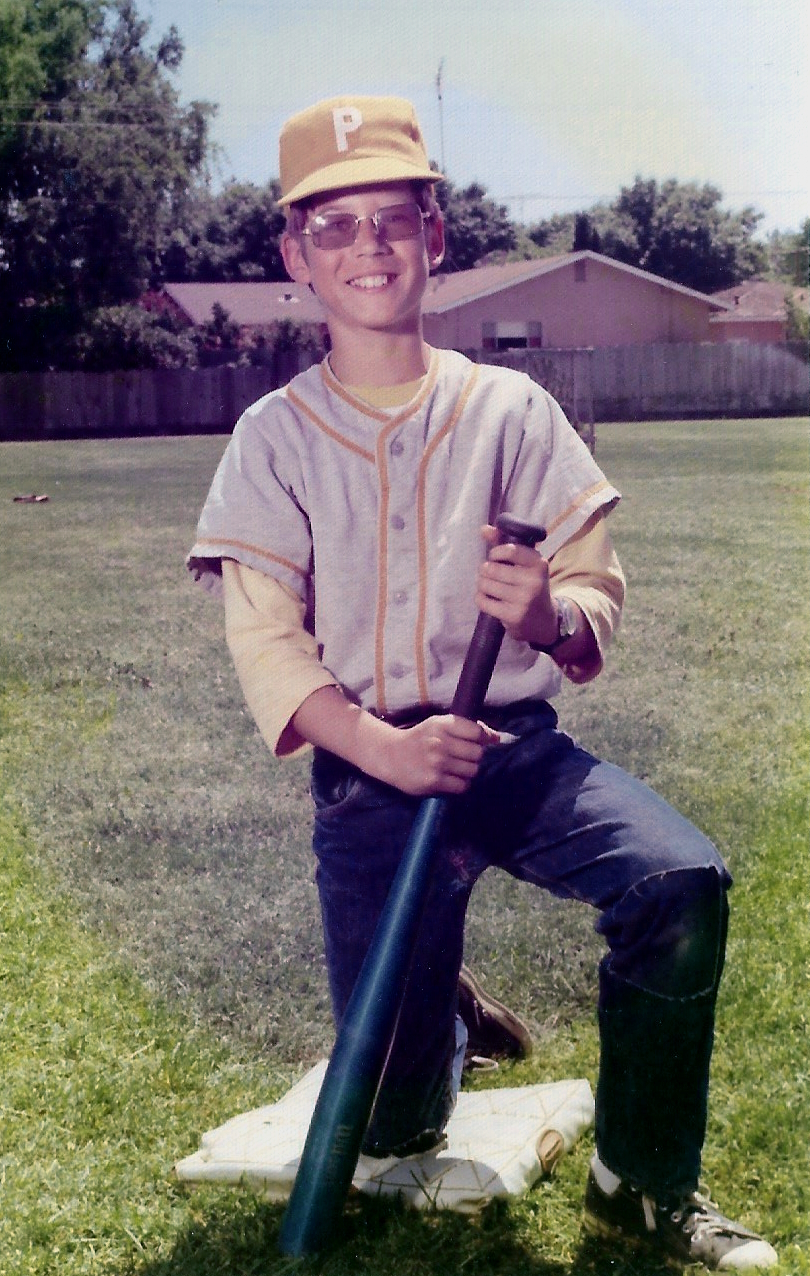
Me at eleven.

 kirkwise