Dune Applied

Perhaps the characters in a story about a violent struggle for control of a galactic empire who rely on martial arts, subterfuge, treachery, and manipulation are not the most ideal role models for a thirteen-year-old junior high school student, but then again. After Walt left I was a hot mess. I had always allowed my emotions to flow outward on clear display and it had gotten me into a lot of trouble. In class I tended to blurt out whatever came into my head, which meant a lot of quality time spent in the hallway on time-out. While I craved the attention these antics brought, it was doubtless slowing me down academically. Adults found me alternately delightful and threatening. Walt had attempted to break my spirit by literally beating the gay out of me. I struggled spiritually, having read the Bible from cover to cover when I was twelve and finding it utterly horrifying. I never told anyone about it at the time, but I will write about it in a separate post. The fact that Walt was supposedly a man of God, an ordained Methodist minister who was as bad an example as I can imagine, left me deeply conflicted. Once I started reading philosophy I quickly became an atheist and turned to science fiction and fantasy literature for usable myths. Dune really hit the spot with its deeply humanistic material. The character Paul Atreides, fifteen years old at the start of the story, was a role model for me. The product of centuries of selective breeding, he was also in the process of receiving deep training in mind control techniques, martial arts, and politics. I found the litany against fear to be incredibly useful in helping me control my own hysteria, the product of post-traumatic stress. It was the perfect formula to encapsulate the lesson of the story of The Mummy Box:

“I must not fear. Fear is the mind-killer. Fear is the little-death that brings total obliteration. I will face my fear. I will permit it to pass over me and through me. And when it has gone past I will turn the inner eye to see its path. Where the fear has gone there will be nothing. Only I will remain.”

I committed this to memory and recited it to myself whenever I felt anxiety. Inspired by the references to gestalt in Dune, I read “Awareness: Exploring, Experimenting, Experiencing” by John O. Stevens, a collection of exercises based on the Gestalt Therapy of Fritz Perls. I began training myself. Paul had trusted teachers guiding his training to prepare him for his future role as Duke. I had Steve (my therapist), my band directors and my piano teachers who I came to see as mentors. I embraced the idea of human potential and became committed to the idea of training myself to the highest possible degree. I became cagey about my true intentions and motives.

I began to observe myself, imagining a hidden camera in a high corner of the room. How did I appear to people, how did this scene “play?” So while outwardly I was still open, honest, emotionally present, behind the scenes there was another me, a director orchestrating secret plans. After Walt I was a person with many dark secrets. I managed those secrets in layers. I cultivated friendships based on trust earned through layers of self-disclosure, carefully listening to the revelations I would receive in turn, reflecting and offering insight where I could. Several young men wanted to be considered my “best friend,” the person to whom they could tell anything and have the confidence protected. They were jealous of each other, competing for my attention. All of them felt they knew me better than anyone else, but none of them ever achieved the security clearance of “above top secret.” There were things I would never tell. Eventually, through reprogramming my own mind using the principles of Psycho-Cybernetics, my deepest secrets were hidden even from myself. My true self and my true history became buried under layers of artifice, and I lost my core. But I had become very adept indeed.

Dune was teaching me how to be a gifted youth in a world of adults. I was learning how to play them, telling them just enough to win them over, but always holding something back. I remember one particular interaction that has stuck with me. I had a friend named Alan, a year older than me and not part of my school friend group. We had met when I was in fifth grade (my fifth grade class was combined fifth and sixth graders). Alan was a real nerd, obsessed with airplanes and also with the book, Airport by Arthur Hailey. Alan’s mom was the librarian at my seventh grade junior high school. Alan had an older brother who alternated living with his father and his mother, who were divorced. When I was still twelve I had a sleep-over at Alan’s house. As is customary in pre-teen sleep-overs we stayed up late. Somehow the conversation turned to time travel. Alan’s brother Jeff, who was a genius but also mildly schizophrenic and probably autistic, took an interest. As the conversation went down the rabbit hole of time-travel paradoxes, Alan lost interest and went to sleep. Jeff and I continued the conversation until dawn. I was trying to convey the idea that if sometime in the future you were able to travel to the past, then whatever you do/did in the past is already part of the history of the present, so it is impossible to “change” the past, even in principle. He insisted I draw up a flow chart, which I had never heard of. So we spent a lot of time trying to get me up to speed on flow charts. By the time he fully understood what I was trying to say, the sun was coming up. Satisfied, he retired to bed, but I was wide awake: it was the first time I had ever stayed up all night!

Their mom came out to brew coffee and start breakfast, surprised to find me at the kitchen table with a paper and pencil in front of me. We got into a conversation that meandered through several subjects, but landed in the realm of philosophy, which I had been exploring recently. At one point she asked me if this map of the universe I was building in my mind had any room in it for the possibility of God. “That’s complicated,” I replied. For the next hour I unrolled my view of the subject, which was agnostic, but probably close to Spinoza’s views of a rational core knitting the universe together. Alan eventually woke up and came out to inquire about breakfast, so we had to wind things down. But how she closed the conversation has stuck with me. “Well,” she said, “I can’t believe I have learned so much from a twelve-year-old. When you become an adult, if you ever decide to start a religion, I would like to become a member.”

That night and morning of deep and stimulating conversations with older brilliant minds left me with a quiet sense of awe and caution. I was awakening to the possibility of the influence I could have on people and I knew this would bring with it certain ethical responsibilities. I remembered the story of the temptation of Jesus on the mountain top. Such powers can easily lead to evil. I resolved to be humble in my goals even as my ego swelled. I came to see my potential as a world-maker and a leader, but it scared me. So through high school I made sure that my growing influence as a trend-setter and social locus was always directed towards good ends. At least, that was my intention.

Intellectual Awakening

All through my childhood I enjoyed prowling around my parents’ tall bookcase where the encyclopedias were kept, along with a wide variety of books old and new. I was fascinated by the old books particularly, which my mom had inherited from her favorite aunt after whom she was named. Aunt Carolyn had lived in Santa Fe, New Mexico with her husband for many years and had collected Indian pottery and rugs, which we also had. The dusty old books were typical of the 1930s, with philosophy, poetry, mythology, fiction and non-fiction titles. I couldn’t actually read these books, but I would flip through them looking at pictures, savoring the old bindings and the musty smell. I was infatuated. One day when I was twelve I picked out one with an intriguing title: The Story of Philosophy by Will Durant. I opened it to the first page and began reading. I’ve mentioned that I was dyslexic. Reading was a real chore for me, and I had never actually read any book all the way through except Hardy Boys mysteries. I had read every one of them in my elementary school library, beginning in third grade. But I had never been able to tough it out through any adult books. Until now. I was strangely able not only to follow the stories about the old philosophers, but was somehow able to comprehend the ideas they grappled with. My mind lit up like a Christmas tree and I was hooked. I just kept reading and reading as a sense of euphoria came over me. My mind was unlocked. In fact, I was puzzled why they seemed to think these philosophical ideas were so difficult. It seemed to me there was a lot of unnecessary struggle over rather easy problems. I had already contemplated the nature of reality and “truth”, the limitations of logic, the importance of symbols and semantics — I just hadn’t realized there was a discipline that had given names to these things and grappled with them. I had found my people.

Book in hand I marched into the kitchen to see my mom. “Mom! I finally figured out what I want to be when I grow up. I’m going to be a philosopher!” Her smile faded and her face took on a look of chagrined pity. “Oh, Honey, there aren’t any philosophers anymore.” I guess I knew what she meant: nobody is walking around in a toga with a laurel wreath on their head, whiling away the hours engaging in Socratic dialogue about the meaning of the word “Justice”. Now we only have career choices like Physicist, Doctor, Lawyer, Engineer. I was crestfallen. The wind had come completely out of my sails, and I made one of the biggest mistakes of my entire life.

I believed her.

I still haven’t forgiven myself for this blunder, even though I know I should. I was only twelve. My mom had a degree from Berkeley. I took what she said on authority. I didn’t know then that taking things on authority was what kept Europe in the Dark Ages for centuries. If only I had asked one of my teachers about it. They would surely have told me that every university offers courses in philosophy, often as a requirement for graduation. Who do you suppose teaches those courses? You can major in it. The world is full of philosophers, some who embrace the label, some who avoid it. At that time I surrendered to the impossibility of doing the one thing that really inspired me, but resolved that whatever I found myself doing after that, I would do it philosophically. I would be a philosopher in secret.

When I turned thirteen my step-mother gave me a book I had never heard of. No one else I knew had ever heard of it either, perhaps because it had only been published nine years earlier. Everyone knows it now: Dune, by Frank Herbert. As I held it and looked at the intriguing cover graphics I felt the weight of it in my hand. I flipped through it: no pictures, only small print. And it was thick. What on earth? She couldn’t possibly think I could read such a tome. She said, “I think you might like it: the main character is your age.” So I began the slog–dictionary at my side. It was slow going, but she was right. I very much saw myself in the character Paul Atreides. I quickly became obsessed with the story, which dealt with topics like arid land ecology, power politics, and deep philosophies regarding artificial intelligence and selective breeding (of humans!). It became my new bible. I had, I just now remember, already managed to read The Bible cover to cover: perhaps in another thread I will explain how and why, and what I really thought of it. This was so much better though, because it was intellectually stimulating and coherent. On the cover of the book were quotes from book reviews, one of which compared it to The Lord of the Rings. That sounded intriguing, so after I finished Dune (it took the better part of a year), I began reading Tolkein. Oh my. By the time I got through high school I had managed to read both trilogies about eight times. I could only read a dozen or two pages at a time, mostly at bed time, with classical music playing on my cassette recorder. Then I would fall asleep.

In my earlier thread (Boom to Bust) I talked about discovering that I could easily get top grades just by showing up to class and paying attention. I wasn’t good at finishing homework, but I would do enough of it to convince myself that I understood the subject. In high school all the cool kids were taking college prep courses, so I followed suit. I was a top student in just about every class. So when my schedule became completely full of music, including before and after school and during lunch as well, I found myself making a cup of instant coffee at ten-thirty or eleven at night to begin working on my chemistry or physics homework. I would finish at midnight or one AM, set the alarm for five-thirty, and do it all again. During my senior year I got sick with walking pneumonia, as one might expect, but it wasn’t diagnosed until after I graduated. But I had no trouble with motivation because my brain was on fire. Even with the grueling schedule, I continued reading on my own in philosophy, mathematics, linguistics, and history. I always had a book with me, which I would pull out whenever there was a pause in a rehearsal or before the start of class. In algebra and geometry there was usually time in class for working on the homework assignment. I would would finish it very quickly, then pull out my book! I remember at a musical theater rehearsal (I was the pianist) whenever we stopped for the director to re-block a scene, I pulled out a book on calculus. Calculus was not offered at our high school, but some of the more advanced kids commuted to the university to take it. Someone saw what I was reading and asked what it was for. I said, “It’s interesting, I want to learn it.” They gave me a weird look and said, “Okay.” Looking back, I think I might have been compensating for a sense of inferiority because I had gotten a late start in taking academics seriously. I wasn’t able to actually take a calculus class until my first year of college, but I did well because I had already familiarized myself with the subject during rehearsals for “Gypsy.”

This all left little time for philosophical reading, but I found time during breaks from school. I liked Descartes, Spinoza, Plato, and Emerson. But I was particularly enamored of two books that I found on the bookshelf at home. One was Out of My Later Years, a collection of essays by Albert Einstein, and the other was Pragmatism by William James. Both sat well with me, raised very few objections. I had finally found a way to harness the madness inside of me and make peace with my weirdness.

Musical Awakening

I am embarrassed to say that I am not a famous musician. Why is that embarrassing, you ask, most people aren’t famous musicians. Most musicians aren’t famous. Heck, this city is full of amazingly talented professional musicians who haven’t even heard of each other! So, why would I be embarrassed not to be famous? Because I was told over and over and over — by people who would know — that I should be. I can’t even go back to visit my home town, because someone would recognize me and I would have to explain why I never got famous. Or I could just point them to this blog, which will explain all the complicated reasons why I have always felt like a failure.

I started out life with no self-esteem, frankly. My parents didn’t have two-nickels-worth of self-esteem between them, so how could they impart any to me? Let’s just blame their parents. Over the course of this blog you will come to learn why I consider my grandparents to have been terrible people, although I have no doubt that they did better raising their kids than my great-grandparents did. I guess we are all trying to learn to do better than our own parents, it’s the human condition. But whatever, in this post I want to talk about how I discovered my musical gift, or curse, depending on how I choose to look at it.

In my previous posts I have tried to describe the experience of having a “special” brain: the kaleidoscope at the center of my mind that constantly dishes up psychedelic imagery in multiple dimensions, the painful oversensitivity of my nervous system, and my difficulties balancing the two realities, inner and outer. It can be a good thing. If I am playing the piano or giving a massage, I can just close my eyes and surf the roiling, colorful model of reality that’s automatically generated within. For me, music has color, taste, texture, geometry, and impetus. I first became aware of this when I was five or six and my parents bought a stereo console. My dad put on Ferde Grofé’s Grand Canyon Suite and I was mesmerized. While everyone else in the room continued to talk or whatever, I plopped down next to one of the speakers, pressed my ear against it and got lost in the sound. Every instrument had it’s own texture and color. My mind followed one melodic line, then another. The various harmonies tasted sweet or sour, hard and soft. Every sensory center within my brain was activated at once, and the rest of the world was shut out. I didn’t understand why everybody wasn’t as affected as I was. I fell in love with music, but didn’t reflect on it that much. I remember sitting in church listening to the organ play, I was maybe five or six. I was moving my feet and fingers as if to play along. Did my mother notice? I remember when it was my turn to load the dishwasher, I was maybe nine, and I found this sharp metal rod with a ring at the end (for holding a roast together?) and I used it as a baton while I imagined conducting a symphony orchestra performing music I was creating in my head. I could hear it! It was for a movie. Again, I never thought it was anything particularly important, just one of the many ways I amused myself with my imagination.

The little town I grew up in had a music program far better than most, for whatever reason. It was customary for kids to start learning their instruments in school in fourth grade. I remember these two music teachers came to our school to give everyone what I thought was a hearing test. They had a device that would generate pitches, controlled with knobs. They made a high pitch and then a low pitch, explaining what they meant by “high” and “low.” Then they would proceed to play two pitches in sequence, and I was supposed to indicate with my hand if the second pitch was higher or lower than the first. This went on for quite a while, and they began to throw glances at one another. Finally they were done, and thanked me. A day or two later my mom got a phone call. She told me it was the music teachers and they had tested my ear. They said they had never seen a kid with such a keen ability to distinguish pitches so close together so reliably, and therefore I should really learn an instrument. They said, given my musical ear and my nice teeth (?) maybe I should learn trombone. For some reason I said no. I think I was intimidated. So I missed out on starting a band instrument when the other kids were beginning to learn.

What I did agree to do was sing in the chorus that was being started at our elementary school. There were kids from fourth through sixth participating, and I thought it was fun. I had always enjoyed singing along with my dad, the Beatles, and to records of Broadway shows. I had a sweet, pure voice. I especially enjoyed singing harmony, which always gave me gooseflesh. Things came to a head when I was in sixth grade. My little sister, now in fourth, had joined the choir with me, and we practiced together a lot, especially when traveling in the car. We sang a lot of rounds. When she didn’t feel like singing, I would close one ear with a finger and harmonize with the drone of the engine. I remember exploring intervals this way, although I didn’t know that intervals have names, or what consonance and dissonance are. But I explored the qualities of all the intervals, even some that don’t have names in the European music system. Anyway, by now the choral program was maturing, and we were preparing for a mass choir performance where the choruses from all the elementary schools in town were to join together in a theater with risers and everything. As the day approached, our director invited the piano accompanist, a professional, to come rehearse with us a few times. That did it. The feeling of euphoria was addicting. The experience of singing on stage with a hundred girls and boys flipped a switch inside of me.

That same year our sixth grade teacher handed out “Tonettes” to the class — a simple musical instrument like an ocarina or pennywhistle, and began to teach us simple tunes using numbers to represent the notes. I learned everything almost instantly. Within minutes I was able to play any tune I could think of. I got looks from people. I didn’t realize it was weird. One day I saw my sister’s clarinet lying on the bed on top of her music book for band. I was curious, so I picked it up and read the instructions. Soon (like, within an hour) I was playing all the songs in the book. She went to my mom, crying, saying “It’s not fair that I’ve been working all year and he can instantly play better than me!” I felt chagrined. My mom had also been working with her for several months from a beginner piano book. One rainy Saturday I was bored, so I sat down at the piano and opened the book to the first page. I read the instructions. Three hours later I came to my mom and said, “Can we get another piano book? I already got through this one.” She looked surprised, but said, “Sure.” So we went from the Primer to the First Grade book of the piano method my mom had learned from as a child. About halfway through that book (a week later) I went to her with a question about some musical notation that I couldn’t understand from the explanation (broken chords). She didn’t remember what that symbol meant, so she said, “Maybe I should find you a piano teacher.”

Turns out there was this wonderful woman who lived on the other side of our block who taught piano. She was a magnificent woman: beautiful, tall, glamorous and graceful. I will never forget that first lesson. She asked me to play for her what I had been learning. She quickly explained the question my mom couldn’t answer, and now I was playing that piece easily. She started to show me different things on the keyboard, and whatever she showed me, I just did it. This was fun! After the lesson I made my way home through the alleyways that divided our city block into four sections. It wasn’t far, but as I came into the house, excited to tell my mom about how much fun I had had and how nice the lady was, I had to wait. She was on the phone, blushing, saying, “Uh-huh. Uh-huh. Oh! OK.” etcetera. When she hung up she said, “Well, that was [name of piano teacher], and she said to me, ‘Carolyn, some day that son of yours will be playing in Carnegie Hall!'” I looked at her. “What’s Carnegie Hall?” I asked. She explained that it meant the teacher thought I was really talented. In fact, she said she had never had a student take to everything so quickly. She couldn’t believe I had been playing only a week or two. During a lesson a year later, a couple of former students walked in, friends of the teacher’s daughter, now in high school. She said, “Wait, you guys, come in here, I want him to play something for you.” She asked me to play the piece I was working on, which I did, with gusto. They just kind of stared, then one of them said, “I remember learning that piece. How come it never sounded so good when I played it?” The teacher said, “I know, right? He’s amazing. I just gave him this piece last week.”

Our town had been growing rapidly and had just constructed a new high school. So the rather unique configuration was now as follows: the high school had 10th through 12th, there was a junior high school that was 8th and 9th grades, and every 7th grade kid went to another junior high school. It was a pretty good system, because seventh-graders wouldn’t have fit in anywhere else, given the awkwardness of puberty. My friend Chuck and I continued in choir in seventh grade, but we soon learned that the “jocks” were not down with that, and we got teased. So we decided that when we got to eighth grade we would sign up for beginning band. Little did we realize that we would now be mocked and laughed at by the kids who had been in band since fourth grade. I understand. Anyone walking into the band room during beginning band would be assailed by a cacophony of horrible honking and squeaking — we were not good. I was learning baritone sax because it meant we wouldn’t have to purchase an instrument, I could use a school-issued one. Chuck wanted to play flute at first, because it would be easy to carry. He switched to trumpet when he realized that those “jocks” whose opinions mattered to him so much thought it was “gay” for a guy to play flute. I found sax very easy to learn: it was just a big fat Tonette with extra levers for sharps and flats. Chuck let me borrow his trumpet one weekend, and I learned to play it pretty quickly too. Later that year I found out that tuba uses the same fingerings as trumpet, but you had to translate it from bass clef. No worries, I could read and write music by this time thanks to piano. After one semester of beginning band I was accepted into the “Varsity” band, the second-tier band. The first tier band at our junior high school was called “Symphonic,” and was one of the best junior high school bands in the region. Both bands were combined into the Marching Band when we went to parades. At the end of eighth grade the band director said, “Hey, if you want to learn bassoon over the summer, you can be in Symphonic Band next year.” So I enrolled in summer school and he taught me bassoon. Bassoon sucks because there are thirteen thumb keys and the double-reed requires a lot of work to master the embouchure. Nevertheless, by fall I was playing in the symphonic band! I had also practiced tuba over the summer, so I no longer had to march with a baritone sax.

In my previous thread I talked about winning the High Achievement in Music award at the end of ninth grade, and how much music I was doing in high school. The gist of it was I had started late but learned incredibly fast. I got my first paid piano gig three years after my first piano lesson. The most common compliment I received was from women who would say, “I could sit and listen to you play all day.” I have small hands for a guy and have always struggled with the more advanced classical literature. But there is something in the way I play, a higher dimension to the sound, that people find amazing. I can’t explain it, but I think it comes from trying to infuse into the music all of the kaleidoscopic wonder that is going on inside my brain. I remember asking my mom early on in my piano lessons why do people do music? She said something about “expressing their feelings and emotions.” I thought, “Oh,” and realized that the beginner-level music I was learning at that point didn’t have much emotional content. So I sat down at the piano and began making stuff up, improvising, in an effort to get some of my many intense emotions out. It was pretty crude at first, but within a couple of years I could improvise for hours and could almost fit my emotions into the “orchestral” fabric of sound I was weaving in real time. That first gig I mentioned: I was asked to play background music for a Rotary Club reception. I improvised the whole set!

By this point music was providing me with an outlet for my emotions, giving me a sense of belonging, and garnering lots of attention and praise. It did wonders for my self-esteem and helped me learn to focus. My mind was beginning to wake up.

Past Lives

Happy to have finished that long thread about my childhood, I think I will celebrate by writing some really crazy shit today. I’m going to go full Shirley MacLaine and tell the story of the three dreams I had when I was about fifteen years old. While I recognize the risk I am taking in revealing such embarrassing details — the risk that you’ll think I’m nuts — it’s probably good to do this from time to time so that my readers will know to take everything I say with a little grain of salt. I don’t know that these are past life memories. It’s just the best explanation I could come up with at the time. And I have yet to come up with a better one.

Most of my dreams are like acid trips: I feel disembodied, everything flows continuously, people morph into other people, scenes mix and change frequently, and it’s hard to form a coherent narrative. But these dreams stood out because they were solid. I could feel my body, including the clothes I was wearing. I knew things about myself and my surroundings, and the flow of time was contiguous, like a single scene clipped from a movie. Each time when I awoke I was still awash in the memory of it, since they were brief enough to remember every detail. And each left me shook.

First let me tell you about my bedroom. After my parents’ divorce, what used to be my dad’s study was taken over by my older sister Karen. It was in the front corner of the house with two windows facing the front yard and one looking into the side yard, which we called the jungle because it was so overgrown. Being on the opposite end of the house from the rooms of the other children, it was relatively quiet. I took Karen’s room after she moved out. I moved the piano and all my sheet music into it, but other than that it was neat and uncluttered. The ceilings in the older parts of the house were fourteen feet high and the windows were tall and narrow. The walls of the room were covered in long strips of brown burlap, which made it even quieter. There was a double bed, quite cozy, and I think for the first time in my life I was able to sleep really soundly. I felt safe in my solitude. Perhaps this is why I was open to having these dreams. Being in my mid teens I was past puberty, above five foot nine, skinny, and becoming aware of myself as a young adult. In each dream I was struck by the differences in my physical form.

In the first dream I was twenty years old and only about five two, but well-muscled. I was wearing some kind of leather helmet and breastplate, like a warrior. I could feel my feet were bound into leather sandals and I remember glancing down at them, seeing and feeling the leather straps binding them to my calves. I was wearing some kind of skirt, canvas maybe, no undergarments. I could feel my whole body, the dry breeze on my legs and butt. It was hot, there were no trees. A large group of us were milling about on the top of this rocky hill, checking our weapons and armor. I remember feeling for the hilt of my sword, giving it a little tug to make sure it was loose in the scabbard strapped tightly at my waist. I remember being pretty confused about exactly what was going on, but I sensed we were preparing for battle, and I knew it would be my first. Suddenly there was a loud shout and everyone started moving at once, heading down the hill. As the people in front of me were now below me, the view opened up as I ran and I could see to the bottom of the hill and up the next hill in front of us. My scrotum contracted in fear as I saw what we were facing: a large force of horsemen in black robes and turbans with long spears and other weapons, now charging down the opposite hill towards us. I pulled out my sword, which was short and wide, and remembered that I was supposed to get close enough to a horse to cut its hamstring as it ran by. I could hope to do little else in this scenario. My senses heightened as the horsemen drew near. There must have been a hundred of them. Suddenly we were in contact and all hell broke loose, total chaos and clouds of dust. I remember dodging and striking at my first horse, spinning. Slightly off balance I turned back to engage another one only to see, too late, that a tall dark-skinned horseman was leaning toward me swinging what looked like a long stick with something round on the end. He sneered and looked straight into my eyes as he struck me on the side of the head. I knew I died instantly in the dream and woke up. Thinking about it, I decided that I must have been Greek, it was sometime BC, and probably in Turkey or Persia. Maybe I was in Alexander’s army?

The second dream was very different. I was tall, at least six feet. It was cold and dark as I meandered through the narrow streets of a medieval city, either Portugal or Spain, from the looks of it. I remember the feeling of leather boots on my feet. The streets were wet from a recent rain. I was wearing long pants, no zipper or fly, a thick wool coat with buttons, and some kind of wool hat. It was late, the street was quiet. I came upon a narrow wooden doorway and went up the creaky staircase to another door. I had a big metal key in my pocket which I used to open the latch at the top door, then I pushed it open with my shoulder. The room was tiny, like a studio. There was a desk in the corner. I lit a lamp, adjusted it, probably oil fueled. It was the only light in the room, but it was on the desk. In the light of the lamp I could see the desk was strewn with papers, not the 8 1/2 x 11 papers we’re used to, but big thick parchment sheets. I took off my coat and boots, left them next to the door, sat down, spread a sheet of parchment, grabbed a quill, dipped it in the inkwell, and began writing in Latin. When I woke up I concluded that I must have been some kind of philosopher, maybe five hundred years ago.

The final dream, which occurred within two months of the first, took place in a mountainous region of Central America, which country I am not sure: probably southern Mexico or Guatemala, and within the past couple hundred years. There was no electricity. I was a woman, around fifty years old, maybe five three or four, and corpulent. I lived alone in a small house with clay walls, very comfortable, with lots of colorful rugs and wall hangings, wooden furniture, and piles of herbs strewn about the kitchen. I had just warmed the water in the wooden tub from a pot I had heated over the cast iron stove, so I disrobed and got in. I vividly remember looking down at my rich brown skin and ample curves as I soaped my body. I remember what it felt like. It was delicious. Next thing I remember I was dry and dressed again. I opened the front door to enjoy the sunset. As I stood on my little porch a group of campesinos came walking by in their brown hats. As the last man in the group was passing by me a few feet away he paused, turned toward me with a look of pure hate, and snarled, “Bruja!” I felt a self-satisfied laugh well up within me and woke up. It seemed like I must have been a curandera but had moved beyond traditional remedies to develop my own innovative practice. I was a very proud, arrogant woman.

I can still close my eyes and picture these dreams perfectly clearly. I remember how I felt at the time, a bit terrified and awestruck–sure that they represented something real, something personal about me. They were so random! Whatever the case, the net effect of the dreams was to give me a sense of life extending beyond the narrow scope of this one incarnation. The physical impression of possessing very distinct forms has affected my self-awareness. When I move I feel that this is just one possible form I could have, and I am not bound to it. Who and what we are is in great part random and accidental, and it’s best not to identify too strongly with any of our particulars.

From Boom to Bust (Part 10/10)

This thread was only supposed to be a handful of posts but it turns out my life has been pretty complicated. As we get into my high school years the cans of worms that open up are too numerous for this thread, so I will unpack them in future threads. There will be a thread describing the awakening of my mind through reading philosophy, sci/fi and fantasy, which led to readings in mathematics and science, social psychology, and military history. There will be a thread on my involvement with music, how it saved my life and gave me an identity leading to endless opportunities. There will be yet another thread on how my alcoholism developed over a ten year period leading to a very hard bottom at the young age of twenty-three. Another thread will deal with my misbegotten relationship with an eighteen-year-old schoolmate that began when I was still sixteen, and how it contributed to my utterly disastrous early adulthood. And there will be a deep dive into my psychological problems, a many-headed hydra that still horrifies me. But for now, let me just tell a couple more stories and sketch out the logistics of how I emerged from childhood a member of Generation-X.

As the winner of the High Achievement music award I was given a scholarship to go to music camp. This was not a mountain retreat. It was held on the campus of a private university, hosted by the conservatory of music there. Kids came from all over the country. It was amazing. There was a junior music camp comprised of a pair of two-week sessions through the month of July, and a senior music camp that lasted the whole month, for older high school students. There was some kind of mix-up which, by the time the dust settled, resulted in my attending the month-long senior camp as a bassoonist. Many of my friends from junior high school were attending the junior camp, and I turned out to be the youngest student in the senior camp. There were sections for choir, band, orchestra, and a piano master class. As a budding pianist I was particularly in awe of the musicians in the piano master class who all seemed to be leagues ahead of me. One day I managed to find — unlocked — one of the practice rooms with a grand piano. I had recently purchased a copy of the Brahms piano sonata in F minor, so I settled down for a first run-through, sight reading, never having even heard it before. While I was still midway through the first movement there was a loud knock on the door. Oh no! I was not supposed to be using that piano as it was reserved for the master class students, and I was a mere bassoonist who had just turned fifteen. I sheepishly opened the door to see two of the guys from the master class. One had just finished high school and was going to attend UC Berkeley the following year. The other was from Las Cruces, New Mexico, who was about to start his senior year of high school. I had heard them both play: they were the best in the class. They together shouted, “Who are you?” I told them I was sorry to be using the room as I was just a lowly young bassoon player, and they replied, “Oh, no, you go ahead and keep playing. We were just wondering who it could be who had the chops to play the Brahms sonata so well. We know no one in the master class is playing it.” I told them I had just bought it and was trying to sight-read it. They were amazed to hear that, and told me I was going to have to hang out with them. After that they took me under their wings and at lunch they introduced me to the master class instructor, a world-famous concert pianist. I was euphoric. I ended up paling around with them all month, walking on a cloud. They told me, “Next year you have to sign up for the master class.” It turns out I did attend the master class two years later, but those details will have to wait for the music thread.

I was also embraced by some older orchestra musicians, one a brilliant violinist and pianist who later became a professional, another a clarinetist who was pretty obviously gay. One of their friends, an alumnus of the music camp who was now in college and also pretty queer, came to visit one day and the next thing I knew I was whizzing along in a car with them to go to a music store. It was strictly forbidden to leave campus except on supervised activities, so I was risking being sent home in shame if it were discovered, but I was too jazzed up by all the attention they were lavishing on me, telling me how talented I was and treating me like a king. The visitor and I got to talking about Rachmaninoff and being bisexual — it seemed a natural blend of subjects at the time. At the music store he bought me the score of Rachmaninoff’s Rhapsody on a Theme of Paganini and said, “You better know this by the next time I see you.” I have never quite mastered it, frankly. Perhaps I wasn’t as good as they thought, but my self-esteem was rocketing upward at the time. And yes, even then I understood that this was grooming behavior, but I didn’t care. They treated me respectfully and I didn’t feel in any danger. I don’t think there was any.

My high school years were dominated by music. I had jazz combo (on piano) before school, symphonic band (bassoon) and marching band (tuba) during school. At lunch time the jazz big band rehearsed (baritone sax). Last period I had music theory. After school I went to the voice teacher’s studio to accompany piano lessons (paid), and on Saturdays I taught piano lessons at the local music store. In the evenings in the fall we had marching band practice for the Friday night football games, and in the spring time we had musical theater orchestra for the big spring musical production. I was busy. But my brain having awakened, I was also taking all the college prep courses, including chemistry, physics, Spanish, psychology, creative writing, rhetoric, etc. I was one of the top students by now. One day my creative writing instructor, a hip/cool veteran of the Vietnam conflict, asked me to stay after class. He inquired about what I planned to do for a living after high school. I said, “I’m kind of thinking composition.” I meant becoming a composer of music. I dreamed of writing movie scores while I improvised on the piano for hours at a time. But he thought I meant English composition and said, “Hmm, I wouldn’t recommend that path for most people, but I think you could actually succeed at it.” He entered my name in a national creative writing competition, but I freaked out and never submitted anything. Awkward! Then my chemistry teacher took me aside and said, “You know, this is a thankless profession and I wouldn’t wish it on an enemy, but you have a special gift. That presentation you did in class reminded me of your father. You could be a great high school chemistry teacher!” The next year my physics instructor took me aside and said basically the same thing, but for physics: “That presentation you did on diodes had everyone hanging on every word!” Finally, my band director asked me to sit down in his office during my senior year (I had never even set foot in his office before!). He asked me about my plans for the future, and by then I was planning on attending the University of California at Santa Barbara for chemical engineering (long story, see girlfriend thread coming soon). He said, “Oh, I thought for sure it would be music. And I would say, don’t even waste time going to college for it. You should head straight down to LA and start doing studio sessions. You’re already better than half of those guys. You know everything you need to know to get started.” Man! I was flummoxed. Too many choices for this neuro-divergent to possibly process. So I went to UCSB because I wanted to learn to surf.

When my older brother, Dan, graduated, he went to live with my Dad. That left just three of us at home. I enjoyed having my little sister in band with me my senior year — she played clarinet. My little brother learned the drum set and played in a punk metal band when he got to high school. As my own graduation approached my mom decided it was time to sell the old Victorian house I had lived in since birth and move ten miles away to the university town where she worked. The escrow closed before the end of the school year and I had to commute the ten miles to finish the last two weeks before graduation. It’s all a blur, but it pretty much ruined the end of my senior year for me. I wasn’t able to celebrate with my friends properly. I never even picked up my diploma. The graduation ceremony was pretty cool, though. There were nearly five hundred students in my senior class. Normally the entire symphonic band would sit on the football field endlessly playing Pomp and Circumstance while the students filed through to get their diplomas. This was a bummer for the dozens of seniors in band who would have preferred to be with family and friends. This year the jazz combo volunteered to play instead. There were only six of us — piano, bass, drums, guitar, saxophone and trumpet — so that freed everyone else up. We played it straight: pomp and circumstance in all it’s regal solemnity. But after a few choruses we mixed it up, doing a blues version, then back to straight. We did a country version, a rock version, and a jazz version too. The crowd loved it!

By the time I was in college my younger brother and sister alternated years living with my dad and I was starting to lose track of where everyone was at any given time. The childhood home was a thing of the past and we were scattering into our adult lives. My older three siblings are all classic Baby-Boomers in their general outlook on life. But I became much closer to my younger siblings who came to define for me the attitudes of Gen-X. We were essentially latch-key kids, on our own for the most part through high school. We each had to carve out a life for ourselves with very little parental guidance or support entering adulthood. All six of us meandered through our twenties, working hard just to survive. We all turned out very different, but we all made it. The older we get, the more we appreciate each other.

From Boom to Bust (Part 9)

My mom was a powerful woman. She was very intelligent, hardworking, and had a strong will. Her biggest failing, in my opinion, was that she was groomed from an early age to serve the patriarchy. She deeply believed that men should take the lead in things and that her role should be supportive. Yet she held the greater power in her relationship with Walt. It was her house. He needed her to help him write his sermons. She made the important decisions behind the scenes, and he must have resented his dependency. Although I never saw him hit her, she was cowed by his temper. He would call her “woman” in a derisive tone. I one time saw him grip her upper arm, hard enough to leave a bruise. There was a time she brought him toast that wasn’t burnt enough for his taste, and he tossed the whole plate back at her. But in the end she sent him packing. His sudden transformation to meekness and his apology to me, after two years of tyrannical domination, left me shell-shocked and confused. At least he was gone. We all felt a sense of relief and liberation in the aftermath.

Content Warning: discussions of suicide and dark insinuations.

My mom made some big mistakes raising us, but now she did something very right. She hauled the six of us into family counseling. Steve was a PhD psychologist and licensed family therapist, and he was great. I remember all of us sitting in a big circle in his office for several sessions, and as I recall it was a lot of fun. He had a calm and cheerful manner that got us all to loosen up and talk about our feelings. I remember there were these oblong pillow things with handles like swords that we could fence with. It was good times, and it wasn’t long before he said, “I think you all are doing quite well and you don’t need to keep coming back at this point. Except I want to continue to see Kirk.” Wow, I felt so special! I mean that in a positive way — I wanted to keep coming, and never thought about why I might be singled out in a negative sense.

So every week it seemed, for the next three or four years I went to see him. In 1974 most kids didn’t have a therapist, and I thought it made me cool. A year into it I bragged about it to my friends at school and they thought it made me a dark and complicated badass. They already thought I was a musical genius. When they asked me if it meant I was crazy, I said I would ask the therapist. He said, “No, you’re not ‘crazy!’ You’re not a raving basket case. I would would describe you as emotionally disturbed.” That satisfied my friends and me. Steve and I talked about my life history up to that point, trying to identify the turning points. I talked about the pants-down spankings, the way I felt singled-out by my father for extra punishments. I decided I must remind my dad too much of himself and so I got on his nerves. I talked about the Catholic school, the bullying. I talked about how Walt seemed to be a cross between Adolph Hitler and Barney Fife: an insecure loser who overcompensated by being a dictatorial douche. But mostly we talked about the bullying that was ongoing: the jocks at school who were always calling me “faggot,” “queer,” and “fairy,” pushing me in the hallways and punching me in the stomach. “What do they think they know about me?” I asked. “Are you gay?” he replied. And that started a long series of conversations about my sexual orientation. He was a good therapist. I never felt judged or in any way unsafe. I could have told him everything, but I withheld a lot. Maybe it was my age. Maybe it was the desperate need to convince myself that the bullies were wrong about me. I think if I believed that everyone could see who I really was and what had happened to me, if I thought I had failed in my attempts to keep the truth veiled, I would actually have killed myself. So eventually we succeeded in getting me through high school in one piece, but the deepest darkest stuff remained buried.

My sister, Karen, started working as a waitress in a small family-owned Mexican restaurant when she was sixteen. She spent a lot of time at work because she loved it. The other reason was because, due to her good looks and outgoing personality, her two best friends happened to be the richest in town. We were dirt poor, and she needed her own money to fit in, at least in a fashion sense. The owners of the restaurant were wonderful people, very kind, and she was a gifted waitress. One day, a few weeks after Walt left, I came home from school hungry. I looked in the pantry for something to eat and we were out of everything but pancake mix and such. I said, “Mom, there’s nothing to eat!” She was sitting at the kitchen table and, for only the second time in my life, I saw her bury her face in her palms and sob. “I’m so sorry, we don’t have any money. We may have to go on Welfare.” That very moment my sister walked in, home from work, and said, “What’s going on?” My mom seemed so ashamed as she explained the situation. Karen said, “Mom, I’ll loan you $75 so you can get some groceries, and I’ll ask at work to see if we can get you a job.” So for a while my mom bussed tables while my sister waitressed. It must have been a hoot. It wasn’t long before my mom got a part-time job lecturing at the university, and a year later she landed a great position at a community health research clinic as “Director of Intervention” in a multi-year, nationwide study. Like I said, my mom was a powerful woman! Her boss was an internationally-renowned epidemiologist, a Persian MD who got all the credit while she worked herself to the bone cleaning up the messes he created with his imperious arrogance. He was not good with people, but she was. She spent the rest of her career there, working fourteen-hour days to make that place a success. He eventually lost a class action lawsuit for harassment brought by all the other employees. She was probably his chief enabler. But at least we had enough money to get a stereo system, a microwave oven, a new car, and a color TV with cable. We were finally middle class.

Halfway through my ninth-grade year the bullying was getting to be too much. My last period of the day was Physical Education. Whenever PE ended, school was out, and I often found myself face to face with my tormentors. Billy, in particular, was not the scariest, but he was the most persistent. The scion of a very wealthy family, he seemed to take special delight in saying things like, “Kirk, you’re a ‘fairy’ nice guy!” One day he said to me, “You’re such a queer,” and I replied without missing a beat, “You wish!” There did always seem to be a sense of yearning in his pretty blue eyes, so I was calling him out! He responded by physically assaulting me with punches and kicks. I managed to escape and headed toward the band room — a standalone building not far away where my friends and I met up every day after school. That was the very last time I attended PE in junior high! After that I skipped PE and meandered my way over to the band room during seventh period. The band director was a sweet man and never questioned my presence there. I would greet my friends when they arrived after school as if nothing irregular was going on. My sister Karen was off at college now, and I had moved into her old room at the front of the house. My siblings were relieved when I moved the piano into it. They were annoyed at how much I practiced, and this made it less intrusive.

Since my mom was working so much, we younger four were pretty much on our own most of the time. My older brother, Dan, had a motorcycle and a job as a dishwasher at a restaurant on the edge of town. He was gone hanging out with his druggie friends much of the time, and that left me with my sister, Jenifer (two years younger) and my brother, Drew (four years younger). We took turns making dinner, which we would warm up for my mom when she dragged herself in at eight or nine o-clock. She would eat and then promptly fall asleep on the couch while we watched TV. By ten someone would run her bath water, then we would herd her off to the tub. We took turns waking her up, helping her out of the tub, drying her off and getting her moving towards bed. This is how we lived. After a few weeks of skipping PE, I started skipping school entirely. I would get up as normal, make my lunch and load it into my backpack with my books, then head out towards school. I found if I walked halfway to school before turning around to go back home it allowed just the right amount of time for my mom to leave for work. I would sneak back into the house and play the piano all day, talking to the composer Beethoven, whose spirit I imagined sitting at my side, coaching me and discussing his music. He was as weird as me, and we vibed together as I developed a special affinity for his piano sonatas. These were the happiest weeks of my life up to then. It was so nice not to have to deal with school anymore.

One Saturday afternoon my mom was reading the mail and she said, “What is this?” I looked at the letter she handed me. It was from the Department of Juvenile Justice. It said something to the effect of “Your son, Kirk, has been declared a habitual truant and will be made a ward of the court if you don’t respond by” such and such a date. Ooops. She looked at me in pained confusion. “But I see you leave for school every morning before I go to work!” Well, actually. I asked what “ward of the court” meant. She said, “They’ll take you away and put you in foster care, probably a group home somewhere.” What, no more private room with a piano?! This was a crisis indeed. “I’ll call Steve,” she said. I still can’t believe how people rallied on my behalf. I’m so lucky. Steve said he was willing to sign a release to get me out of PE for the rest of the year, and the school counselor told me the principal said they would only accept it because Steve was a doctor of psychology. The only caveat was that I would have to take one more semester of PE before I could graduate from high school in three years. Whew! And the band director said he was perfectly happy to have me as a student aide last period for the rest of the year. I couldn’t believe it, I was getting everything I wanted. But they said I had to sign a written contract, which I was to draft myself. So I wrote up a contract saying I would attend every class until the end of the year on the condition that I didn’t have to set foot in the gym again, and if I had even so much as one unexcused absence I would immediately be made a ward of the court. “Wow, that’s pretty draconian,” Steve commented, “Don’t you want to give yourself three strikes or something?” I straightened my back and said, “I don’t see any reason why I would have any unexcused absences.” So we both signed it. I discovered that merely by showing up to all my classes every day I could easily get straight A’s, and at the end of the year I was even presented the “High Achievement in Music” award in front of the whole school. To this day I still believe that if I had gone into foster care I would have died of a heroin overdose or suicide before the age of twenty. Thank you, Steve, you are still a hero to me!

Radical Acceptance

Tomorrow I will resume work on the thread I have been doing about “From Boom to Bust,” but on this day I feel I should take a moment to offer a few reflections on sobriety. No one asked me to give a speech, but it’s my blog and I have the prerogative to say a few words here if I want to.

Today happens to be Saint Patrick’s Day. It is also the thirty-ninth anniversary of the day I decided to try sobriety one last time. This morning began as all mornings do, fixing a cup of coffee for myself to have during my first chess session of the day. My wife, Sarah, gave me a little squeeze of appreciation as she congratulated me for making it through another year sober. I smiled. A few moments later my phone buzzed with a text message from my ex-wife, Laura, also offering a celebratory sentiment. This year we will have been divorced for thirteen years, having been married for twenty-two years before that. She is the mother of my biological children. I thought to myself that it’s nice that we still wish each other well. My mother sent me a “birthday” card every year for as long as she was able. Reflecting on all this made me think, “Wow, what does it say when there is a general consensus that the world is a better place just because I don’t drink anymore?” I guess my drinking must have been pretty bad.

I came-to that morning of March 17, 1985, which also happened to be a Sunday, after a crazy binge that began Thursday after work. There will be future posts with more details about how I had hardly drawn a sober breath for the previous eight months, but suffice it to say for now that what made this Sunday morning different from the previous ones was not the fact that I was contemplating quitting drinking. What made it different was that for some reason I realized that it was a loop: I had been having these thoughts every Sunday for weeks now. I would resolve to take a break, if only to clear my head and get a little perspective. But by Monday I would forget, and find myself drinking again as if my resolution had never happened. This had been going on for weeks, and only on this occasion did I have the mental clarity to realize I was stuck. Eight months earlier I had come to a point of radical acceptance of my fate. I was moving out of the apartment I shared with my then girlfriend because my new love interest wouldn’t have sex with me as long as I was living with someone else. Why? In her words, “because I’m decent.” That left me no choice but to get my own place. As I was leaving, my girlfriend tearfully asked me why I was being so cruel. I looked at her intensely and said, “I’m doing this to protect you. I’m dying, and there’s not a damn thing you or I can do about it. I’m getting out of your life to spare you.” In that moment I had every intention of dying drunk, and I knew it wouldn’t be more than a year before it happened.

My parents had also reached a point of radical acceptance. They hadn’t heard from me in months, but they had a sense of what was going on. Divorced for years, both of them were attending Al-Anon meetings in their respective towns. My dad had twenty-one years of sobriety at that point, but his biggest challenge had become what to do when your child is dying of the same disease. They prayed for me and had their friends praying for me also. Both braced themselves for the seemingly inevitable bad news that could arrive at any time, probably from a third party, that I had met my end. It was a dark time.

But that morning was different, somehow. The miracle arrived in the form of a question: what if I am wrong? I had acquiesced in the knowledge that it was my fate to die drunk. I had stopped fighting it. I was embracing it. I had burned all my bridges and was just trying to go for all the gusto I could on my way out. People I didn’t even know were stopping me and offering warnings and advice, it was so clear from my behavior that I was going to flame out. It must have been sad to know me then. But that morning, for some reason, it occurred to me that maybe I was wrong. Maybe I wasn’t meant to die drunk. What if I was supposed to recover? That was a terrifying thought, because every aspect of my life was a complete shambles. To try to turn things around now was going to be incredibly difficult. Even just my financial situation was astonishingly hopeless. I had just lost my latest girlfriend, I was about to lose my job, and it seemed like no one at all was buying my horseshit anymore. I had run out of cash and had only enough in my pocket to buy a pack of cigarettes or a six-pack, but not both. When I realized that I had been vainly trying to stop for several weeks and forgetting each time, I realized that this might be my very last chance.

As I sat there contemplating the question of which fate I might be destined for, another question hit me. What if it’s a lie? What if the one thing that has been making my life a little bit bearable, the one thing that gave me a moment or two of relief from the hatred I felt for life and for myself was actually causing all the problems? What if instead of being my one true friend, alcohol was actually what was killing me? If that were true, I owed it to myself to at least try to get sober one last time. Ugh. But if it were true, and I were to pick up that next drink and begin the slippery slide to oblivion knowing what I knew, it would be very embarrassing, to say the least. What a fool I would have been! So, that’s how it started. All these years later, I have still not picked up that next drink. It turns out that it was not my destiny to die drunk after all.

I brought my phone to my wife to show her the text from my ex-wife, and made a wry comment about how bad my drinking must have been for everyone to celebrate the fact of my sobriety. But neither my current wife nor my ex-wife has ever seen me drink! Sarah said, “Well, it’s always been clear that your sobriety is very important to you, so I’m happy for you.” I didn’t know whether to laugh or to cry. Of course it’s very important to me. It is the foundation of every good thing in my life, everything valuable thing about me as a person. Yes, it’s very important to me. Sometimes I mention to someone that I have been sober for a long time and they respond with, “You must be very proud of yourself!” No. I went back to college in my fifties, thirty years after I dropped out, and busted my butt over the next three years to graduate with a double major, summa cum laude. I am very proud of myself for that! But sobriety? I only feel gratitude for it. Grateful that I escaped the whirlpool and I don’t have to do that shit anymore. And I am grateful every single day that none of my kids has ever seen me drink. Very grateful, indeed.

I wrote a post a few years back called The Wisdom Prayer in which I talk about how pointless it is to accept anything that is not an actual fact. For example, for thirty years I accepted the “fact” that I had missed my chance, that it was too late to go back to college! People in recovery sometimes seem to elevate the idea of Acceptance into some kind of general principle, as if it is the key to everything. But like trying to use a screwdriver when what you need is a wrench, practicing “acceptance” in the wrong situation can keep you stuck in a victim mentality. In such situations what is needed is Courage, and to know that, you need Wisdom. But I want to share something, a fact which I have accepted as such all the way to the core of my being. When I think about all the things that could possibly happen to me — illness, bankruptcy, tragedy, horror — I am unable to imagine a situation that I couldn’t make worse by taking a drink. Honestly. That particular form of radical acceptance keeps me sober.

This is the first year I can remember where I haven’t had a single drinking dream. You know, the nightmare in which I am at some sort of social gathering walking around talking to people with a half-finished drink in my hand. I suddenly realize that I am drinking and wonder, how long have I been doing this? And in the dream I think back and realize that it has been happening for a while now, and that somehow I have lost my sobriety without even noticing. I take these dreams as a warning. In my youth (I was twenty-three when I took my last drink), whenever I would resume drinking after a few weeks or months it would happen without fanfare. No drama. I would just “forget” somehow that I wasn’t drinking. I have no doubt that if I were ever to start drinking again it would happen like that. Terrifying! But I haven’t had any of those dreams this year, thankfully, not even during the Annual Dreary Rehash. The past year has had it’s share of challenges — a couple of colonoscopies, people around me having mental and physical health challenges, financial stress, a sense of impending doom for Western Civilization — but I have a good life. I believe that as long as I am grateful every day for the gift of release from the horrors of alcoholic drinking, I will be fine.

From Boom to Bust (Part 8)

The last installment ended with a teaser about the next two years, and there will be a lot more detail and analysis in future posts. For the purposes of this thread, going from barely being a baby-boomer to fully joining Generation-X, I will start with a snapshot of how the two years ended. One August day I was sitting at the playroom table playing with the chess set. I think I had just finished a game with one of my brothers (“almost fifty-years-ago” is a long time to remember tiny details). I heard some commotion as people moved through the house from room to room. This big old Victorian house had a lot of rooms and most of them (all but two) had doors connecting them to multiple other rooms. For example, the “girls bedroom” had four doors, one leading to the middle living room, another to the dining room, another to the adjacent bedroom, and the fourth leading to the master bathroom. The playroom opened to two different bedrooms, the dining room, the laundry room, and the back bathroom. There were any number of potential paths through the house! I heard voices and footsteps making their way on one such path, people talking, more footsteps. Something was off, but I was locked into the fascination of what I was doing and was suppressing my growing sense of unease. Walt emerged from the boys bedroom and stood over me, my mom, sister and brother trailing behind. I looked up, flinching a little in preparation for whatever might be coming, but was shocked to see tears staining his face. I had never seen him like this — he had become a completely different person yet again. He seemed smaller, cowed like a contrite child. And then he did the weirdest thing: he stuck out his hand for me to shake, which I did, and through his tears he said, “I’m sorry.” As he walked away, someone whispered to me, “He’s leaving.” Mom had finally stood up and told him it was over.

Content Warning: This post contains a graphic depiction of domestic violence.

Victor Frankl in his book, “Man’s Search for Meaning,” describes the reaction of the prisoners when the Allies unlocked the gates of the concentration camp in which he was interred. They wandered out the gate into the forest, looked around a bit, then went back to their barracks. They couldn’t yet process the reality of the liberation they thought would never come. I was similarly in shock. In fact, all of us kids were showing clear signs of trauma, which had led my dad to ask his lawyer about beginning a custody challenge. But my mom had already begun to take control of the situation. To give Walt time to leave and to allow us to decompress, we were sent to spend a week at my dad’s. My eldest sister, who had previously gone to live with him, was now eighteen and a militant lesbian. She came at my mom’s request to stay with her in the interim, lest Walt return to cause trouble. It was decades later when I learned from her that she had borrowed a gun from a friend, just in case. So the consensus seems to be that the situation had become pretty scary.

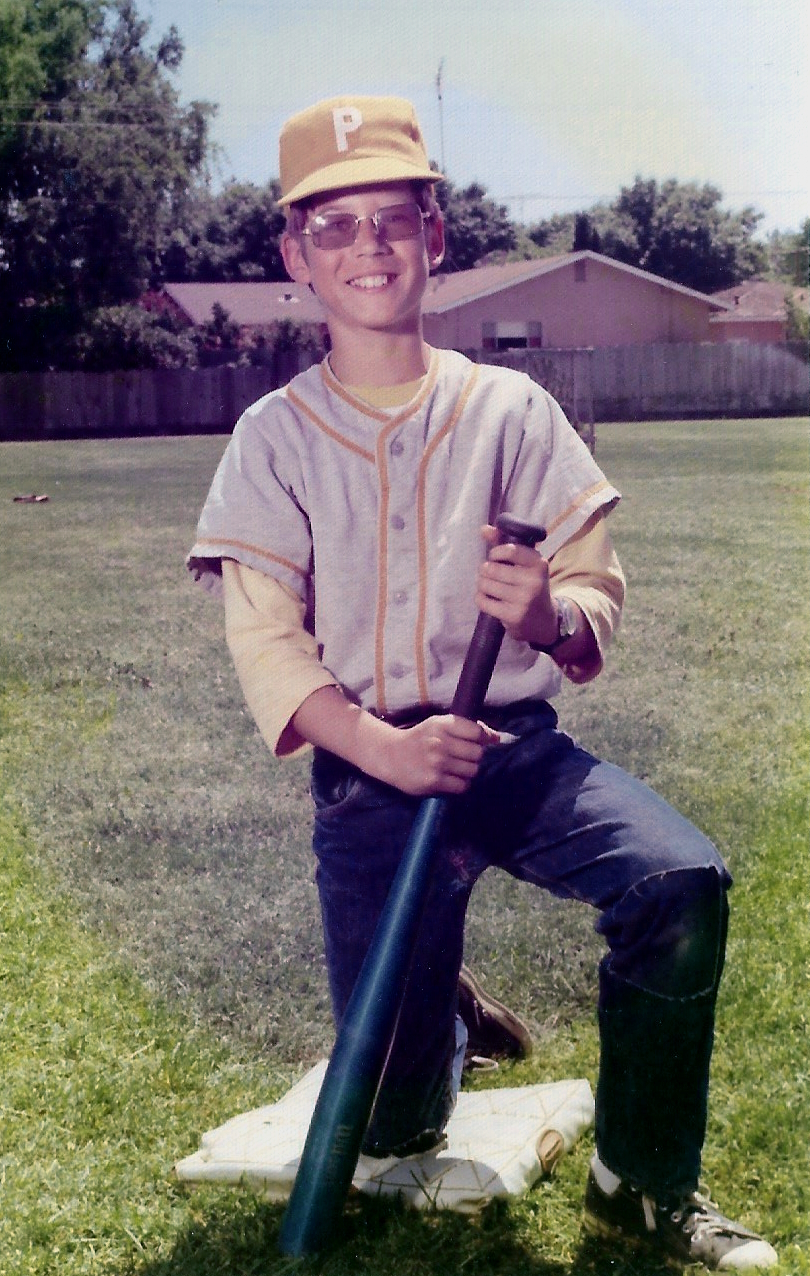
On a lighter note, I want to tell you how my infatuation for baseball ended the previous year. There were three levels of little league: majors, minors, and California league, in order of skill level. My first year I was in California league (my team’s name was “Bakersfield”), but in my second year I was good enough to be on a minor league team, the Padres. So I guess we can say I was an intermediate player. I usually played right field or second base, although I do remember subbing at third base on occasion. I was once shocked by the speed of a line drive that came right up the third-base line. I caught it, but boy did my palm burn from the impact! I decided I preferred second base. Anyway, we were a pretty good team that year. Our hitting and fielding were strong, but our pitcher…he was the head coach’s grandson and had a love for baseball that exceeded his talent. He was a real pitcher: he could throw fastballs, change-ups, curves, and sliders. The one thing he couldn’t do was throw the ball over the plate. Every single inning it seemed the bases were loaded with runners who had been “walked.” If only we could find a way to get our other players into the game! So one day at practice, in despair, the coach let each player on the team take a turn at pitching. I had no idea about fancy aerodynamic techniques that required putting spin on the ball, but I could throw hard, fast, and straight. All those hours throwing balls against the back steps finally paid off, I guess. So I became the new pitcher! I met someone later who remembered playing against me, and he said, “Oh, I remember you! I loved coming up to bat against you, because you would throw it straight over the plate. I could always hit it!” At least I wasn’t walking people. And when they did hit my pitches, which was often, it created a chance for the rest of the team to deploy their skills, which were very good — so good that we found ourselves in the championship game at the end of the season! Sadly, it all ended in a Charlie Brown moment when I had to be pulled out during the game because for some mysterious reason I just couldn’t throw straight and we ended up losing the game. It was weird. Only later did it occur to me that playing for hours the previous day in a neighbor’s swimming pool was the cause. It was something we all knew not to do the day before a game, but I had forgotten all about it! It’s so sad to think that I was on the verge of being a hero, and wound up being the goat. After that I aged out of little league and was not good enough to continue to the next level. But by that time I was discovering my musical talent, which changed everything.

During the two years of my mom’s marriage to Walt our world was sharply bifurcated into two irreconcilable realms. My dad had become a laid-back, west coast, “enlightened” male. (The pants-down spankings had ended when he moved up to Washington for grad school.) He and his wife didn’t have a television, but did have a nice stereo and a collection of classical, folk, and jazz albums that we could listen to around the fire. I remember him smiling through his beard as he put on his apron to cook his classic eggplant stew, a recipe he found in Sunset Magazine. During the summer we would walk through a redwood grove to get to the edge of the Russian River a quarter mile away from their house, hanging out on a patch of sand where the little creek fed into the river. Directly across from us was a famous nude beach where dozens of naked hipsters would peacefully relax to the sound of bongos or guitars, the smell of weed often wafting in the air. My dad, stepmom, and sister would routinely skinny dip too, and we younger kids who didn’t live there all the time were free to join in if we wished. Family nudity in that setting never seemed awkward or uncomfortable to me, but it would have been unthinkable in the context of the rest of the extended family. The tone at my mom’s house was utterly different. Walt was a bit of a country bumpkin. He had no taste or sophistication of any kind. Whereas my dad would play the ukulele and sing Woody Guthrie songs, Walt could perform only one song: “How Great Thou Art,” a plodding, cringey, hymn. Whereas my dad could entertain a large audience to thunderous applause, whenever Walt performed his song people winced, either from the forced baritone of his untrained voice, or from the forced emotional display of his performative Christian faith. Because let me tell you: in spite of being a minister, that man was a spiritual pygmy. (Oops, no offense to actual pygmies, who no doubt possess authentic indigenous spirituality.)

One of the many things I used to love about professional baseball was the singing of the National Anthem before the game, with all the pomp and ceremony. Back in those days the solo was not a performance, per se, but was for the purpose of leading the crowd in singing. That seems to have been long forgotten, as now-a-days pop stars often butcher it in a way that leaves the audience out. I loved singing along. The cultural divide between the two households can be seen in how my two father figures differed on their assessment of the suitability of The Star Spangled Banner as a national anthem. For Walt it was a sacred hymn, and to besmirch it would be equivalent to flag-burning or blasphemy. But my dad had a more nuanced view. He pointed out that the verses of the poem were damn-near unintelligible, and if one did do the work to parse them out, the meaning was mostly militaristic. Plus, it was set to the tune of an old drinking song that required a range of a full octave and a half, something only trained singers can handle well, and then only when it’s “in their key.” America the Beautiful, on the other hand, is a lovely yet sing-able melody with words that warm the heart with vivid images of the natural assets of our land. There was no comparison: the latter should really be the national anthem.

One day, when I was twelve, Walt was watching the beginning of a baseball game on TV and I stupidly decided to articulate my dad’s position on the question of the two songs right in the middle of the singing of the anthem. Bad timing, I guess, but it also poked at the heart of a war that had been quietly raging between them for influence over my soul. It seemed I might be choosing sides. Walt became very angry that I would have the audacity to question the unquestionable nobility of our sacred national song, and voices were raised as we argued back and forth. I finally blew up and shouted at the top of my lungs, “I HATE the national anthem!!!!” and ran from the front living room all the way through the middle living room, dining room, and girls bedroom to finally arrive at the boys room. I slammed the door behind me and threw myself on the bed, sobbing.

In fact I did not hate the National Anthem. I loved it dearly and I dreamed of being able to lead the crowd at a baseball game in the singing of it myself one day. (It so happens that I have, many times, as lead in a barbershop quartet, but I digress.) But that’s not really what any of this is about. This is about the war between “The United States” and “America,” between Pepsi and Coke, between Jazz and “Country” music, Blue and Red, my safe cool dad versus this toxic troglodyte in a tractor hat. Boom, boom, boom, boom, I heard heavy footsteps on the wood floors coming towards my room. The door burst open and he pounced, slapping and punching me about the head and shoulders. I tried to shield my head with my arms, so he pulled them down to my sides and straddled me to keep them pinned as he continued his assault. This was the most uncontrolled rage I had ever witnessed from him, and that is saying something. Of course, the whole family arrived right behind him. I remember my older sister, Karen, shouting, “get the hell off him, you asshole!” and my two brothers actually trying to pull him off. As usual, my mom stood there, helpless in the moment. But as I described at the beginning, she was ultimately able to get him out, and thus began our next chapter.

Me at eleven.

From Boom to Bust (Part 7)

From the ages of nine to twelve baseball played an increasingly important role in my life. I was certainly not great at it, but I spent many hours playing catch, three-flies-up, and throwing a tennis ball against the back steps to hustle for the rebound. I adored my mitt like a favorite pet. I would oil it carefully, massage it, and rub it against my face to revel in the leathery smell. I loved the sound of a baseball smacking into the pocket. The game of baseball is very structural: the time and space relationships, the way the various positions must coordinate to move the ball around the diamond, the partition of blocks of time into innings, the count of balls, strikes, and outs. I was fascinated by the relatively narrow space between pitcher and catcher, standing ready to intercept the ball with my bat if only I could read the speed and trajectory correctly. I loved the uniforms. I spent many hours attempting to draw pictures of myself in major league uniform. My art skills were limited, but I used pastel crayons to try to get the colors just right. I was obsessed with the Oakland A’s professional baseball team, who were heading towards three consecutive wins in the World Series.

My dad was not really into sports at that time and I only remember playing catch with him on a few occasions. But my mom’s new boyfriend and his son were very avid about baseball. Walt coached a little league team in the nearby town where they lived, and I think they won their league. Blaine, his nine-year-old son, was a gifted player. As we began to spend more time together, he and I (a year older) became inseparable. We played baseball, rode bikes, and got into the various kinds of trouble together to which boys that age are prone. We were buddies, and I ended up spending a lot more time with him than my two brothers. If I was ten, then my mom would have been forty, and Walt was in his fifties.

Here’s what I came to know about Walt’s biography. My mom met him in Al-Anon, as his second wife was an alcoholic. I’m not sure if she died or was just institutionalized, but it was unusual in 1971 for a man to be a single father. Actually, Walt had several children from his first marriage, which ended in divorce when he “took up with the town barfly,” according to my mom. He had been the pastor of a small Methodist church in a mountain town, and the scandal led to his “defrocking.” Everything I am telling you is what I heard from my mother, so I don’t know any other facts. Anyway, he was now teaching sixth grade P.E. at yet another small town to the west of us. Originally from rural Pennsylvania, Walt grew up on a farm in a large family, abandoned by his alcoholic father for the most part, except when he would swing by the farm and cause a ruckus. My mom said Walt’s dad was physically brutal, but Walt was very attached to him. Walt’s “glory days” were during the Second World War, where he served as a corporal in Patton’s Third Army. General Patton was his hero. And everything I am telling you is sprinkled with “red flags,” isn’t it?

Walt and Mom dated through my fifth-grade year, and things were actually really nice. He was teaching me baseball. One of the greatest things I ever experienced was piling into the car and going down to Oakland to see the A’s play in real life. We also took a trip to Disneyland! I was really looking forward to their wedding in the summer of 1972. But he and Blaine had their little quirks. Blaine seemed to have no conscience or empathy of any kind. Whenever he got in trouble he lied his way out of it with ease. Adults were like cartoon characters to him: if they got mad about something, he just laughed at them. He never seemed to feel guilty about anything! I was the opposite. One time we were visiting them at their small apartment and Walt was sitting at the table playing solitaire as Blaine and I watched. Walt smoked a pipe regularly and had chronic post-nasal drip that caused him to sniff frequently. He wore dentures, so he made frequent mouth noises whenever he was thinking, as if he were trying to get them into the right position. His balding head was glistening with sweat and he adjusted his horn-rimmed glasses repeatedly as he concentrated on the game, which Blaine and I were following closely. With nervous little flutters of his fingers, he would surreptitiously re-order the hidden cards whenever he ran out of moves. “You’re cheating!” Blaine chided. We both laughed as he did it again. “I’m not cheating!” he replied, bristling at the accusation. He did it again. Blaine and I were giggling, because his cheating was so obvious yet the way he went about it was so sneaky it seemed he actually thought he was getting away with something. He refused to cop to it and seemed to resent us trying to call him out.

So 1972 was a bit of a magical summer. As the wedding approached I felt euphoric at the prospect of being his step-son, and Blaine and I were going to be step-brothers! The wedding was held at the Protestant church we had been attending for the past year. A note about that: my little sister Jenny cried one Sunday morning, saying, “I don’t want to go the laughing church!” her voice trailing off into a whining sob. She cried and whined a lot in those days, and we teased her for it. But she had a point. We had grown up going to the Catholic Church for Mass every Sunday morning. To us it was The Church. Every non-Catholic church was a fake church. Real priests never married. At the Protestant church the minister had a wife and children. Fake priest! Fake Communion! Fake church! And whereas at the Catholic Church the congregation maintained the proper decorum of somber penitence, when the UCC minister would tell a funny story in his sermon, the people would laugh out loud like it was a comedy club. We kids were mortified by the sacrilege of it all. But we eventually got used to it, and even learned to enjoy the more relaxed and friendly atmosphere. The people there were really nice, actually. After the joyous nuptials, my mother and her fancy new hair-do headed off with Walt for a three-night honeymoon at a tacky motel a few miles away.

While they were gone my sister Karen, sixteen, was in charge. We did fine, although the house got a little untidy, as you might expect with six kids unsupervised for four days. What happened next is something none of us expected. The front door opened and my mom called out, “We’re home!” Footsteps were coming down the main hallway. Walt appeared, at least I thought it must be Walt, but he was unrecognizable. His eyes were rolling back in his head, his tongue was pressed against the backs of his teeth, curling to punctuate the snarl on his face. He began yelling obscenities and tossing things about, excoriating us for having trashed the house and shouting orders at us to clean up this and that. I was numb with terror as I attempted to comply. My mom stood there in shocked horror but said nothing. I guess the honeymoon was over.

There will be more threads detailing the next two years, but this is how it started. Many years later I asked my little sister Jenny what she recalled of those times, and she told me, “Nothing. I just remember feeling sick to my stomach for two years.” Unfortunately, I remember far too much.

My Mom, Walt, my brother Dan to the left and Blaine to the right. I am between them in age, but am not pictured.

From Boom to Bust (Part 6)

Before I continue my story I want to pause and check in. I thought it would only take about a half dozen posts but we are barely halfway there, so I apologize. It’s also taking more time for me to draft each post as we go, as my memories get very muddled in these middle years, and the topics are increasingly complex and painful. But if you are reading this I take it to mean that something here has grabbed your attention enough to get you this far, and I think if you stick with me you will be rewarded. I also want to say that, as dark and hideous as things are about to become, everything I write is from love, compassion, and gratitude. I have reached a place of healing and equanimity, and it is the hope that something I say will help someone somewhere that impels me to write. So, thank you.

My dad and his new bride relocated to the wine country along the Russian River, a couple hours away by car. We visited one weekend a month. He was a reliable ex-husband, always picked us up when scheduled and never missed a support payment. Unfortunately, it was not enough to survive on without my mom getting a job. She was a registered dietician and found work in institutional settings such as retirement homes and Meals-on-Wheels. We got by. She found friends in the Al-Anon groups she had been attending for years and spent many hours on the telephone “talking program.” She eventually started dating one of the men she met at a group.

Not long after my dad and step-mom established their cool hippie lifestyle in a rented cabin across from a Russian River resort, an incident occurred that shifted the configuration of our family significantly. My eldest sister, Stephanie (I have decided to start using first names), was a classic “problem child.” Famous for her outbursts of temper, anti-social antics, and frankly bizarre manners and beliefs, she could be forgiven for two reasons right off the bat. She was a genius, frankly. She told me once that beginning at the age of fourteen she read between one and four books a day. A. Day. And she remembered everything: author, publisher, year, table of contents. She could not only quote what they said, she could explain what was good and bad about it, and what others thought. Amazing. I remember one time not too many years ago discussing a rather thorny topic with her, one that not everyone even knows exists. She popped out with, “Well, have you read [such and such a book] by [three authors]? It’s from the early 1980s, so it’s a bit dated, but in the third chapter they talk about [such and so] and they say [this].” She was not showing off: it was truly helpful to my understanding of the subject. (She passed away in 2016 and I am tearing up writing this: I miss her so.) The other reason was that she was born with a congenital syndrome that required her to have dozens of surgeries over her lifetime. Developing cancer was a side-effect of the syndrome. She lived with post-metastatic cancer for twenty-five years before succumbing. So the second reason was that she had suffered a lot from this malady, and frankly just never really felt well.

In her early teens, Stephanie and my mother would get into arguments on a regular basis. It was like two cats fighting, because my mom was gifted as well. The volume would increase and the pitch would rise as their verbal kung-fu fights soared. On this particular occasion the crescendo was suddenly punctuated by a loud pop, a horrid gasp from my mom followed by a quiet “oh,” and then silence. We all gathered around to find my mom looking down at the floor, a hand held to her reddening cheek while Steph stood there panting, arms at her sides, staring as if she had just come out of a trance. Everyone was in disbelief. Had she slapped Mom across the face?!?! Inconceivable. Silently my mom made her way to the telephone a few steps away, sat down and dialed. “Ed?” she said. “You’re going to have to come pick up Stephanie. She’s going to have to live with you. I just can’t handle her anymore.” Stephanie never lived in our house again. My dad was good with her. It turns out his master’s degree was in working with at-risk youth, drop-outs who were working to finish their high school education. His libertine lifestyle and laid-back vibe turned out to be a good fit for her, since she was already hanging out with bikers and using drugs. He had only a few simple rules for her and she followed them.

So my middle sister, Karen, one year Stephanie’s junior, took on a lead role as Mom’s assistant as we continued muddling through as a single-parent household. In another year, my Mom would remarry, but that is for the next post.